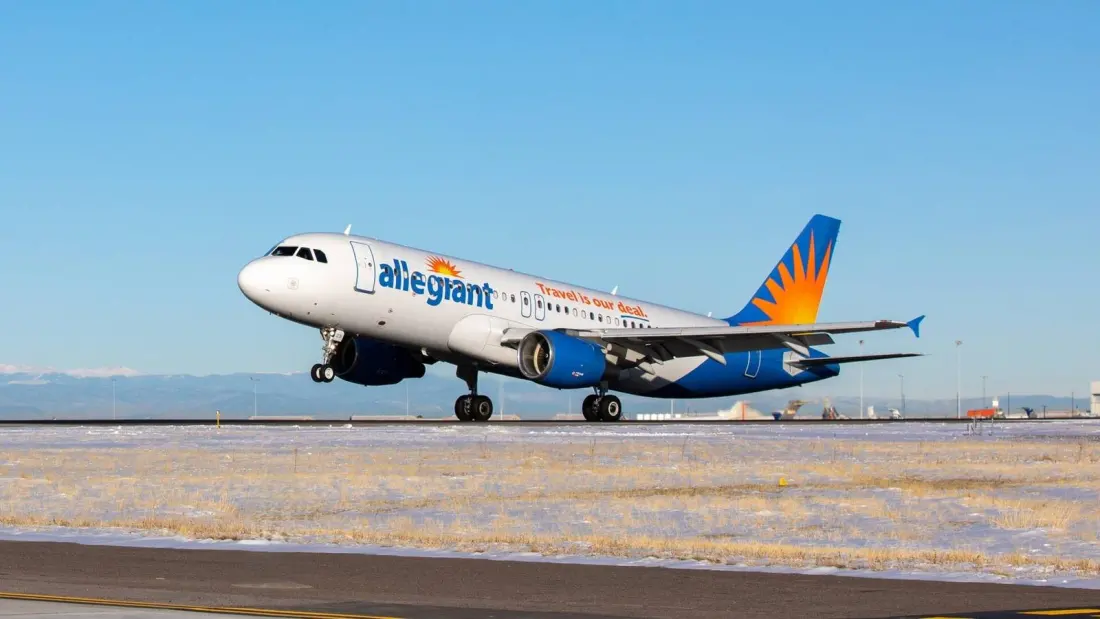
Allegiant Air fills about 84% of its seats across its network, and it does so with an average one-way base fare of just $60. But not every route shares in that success. US Department of Transportation data for the twelve months to June 2026 shows a handful of the ultra-low-cost carrier's domestic routes flying with planes that were barely half full — and in one case, barely a third full.
The worst performer was Orlando Sanford to Columbia, South Carolina, which averaged just 36.4% full and carried around 11,700 round-trip passengers before being pulled. Punta Gorda to New Orleans (44.1%) and Knoxville to South Bend (46.2%) followed, and both have also been cut. In fact, of the eleven routes on the list, most no longer exist. Only three survive: Tampa St. Pete to Huntsville (47.7%, launched March 2026), Las Vegas to Phoenix Mesa (52.5%, returning next March), and Washington Dulles to Knoxville (53.7%, still running).
The Knoxville–South Bend story is a good illustration of how Allegiant experiments. The 370-nautical-mile route ran on and off for 13 months, with nine of those months below 50% full — remarkable given the airline's network-wide average. Similarly, Newark to Flint lasted only one summer season. Before Allegiant arrived, just 340 round-trip passengers made that journey annually, all connecting elsewhere. The new nonstop at $49 each way pushed traffic to 4,172 passengers and gave Allegiant 95% of the market — yet it still wasn't worth keeping, and the route ended within months.
It's worth remembering that load factor alone doesn't tell the whole story. Some loss-making routes lose money slowly and deliberately, and most airlines tolerate a degree of route churn as they test new city pairs. Allegiant's point-to-point leisure model means a weak route can't lean on connecting traffic elsewhere in the network to justify itself, though — if a route doesn't work locally, it goes.
For travellers, the takeaways are practical. First, Allegiant's emptiest routes are disproportionately small-city pairings in the Midwest and Southeast, often seasonal — so if you rely on one of these thin routes, book early and don't assume it will return next year. Second, the flip side of weak demand is genuinely cheap fares: several of these markets launched with one-way base fares under $60. Third, Allegiant is quick to cut its losses, so a route announced for one season may vanish from the schedule entirely. Check current schedules before building a trip around a secondary airport pairing like Sanford, Punta Gorda, or Flint — they're cheap precisely because they're experimental.