
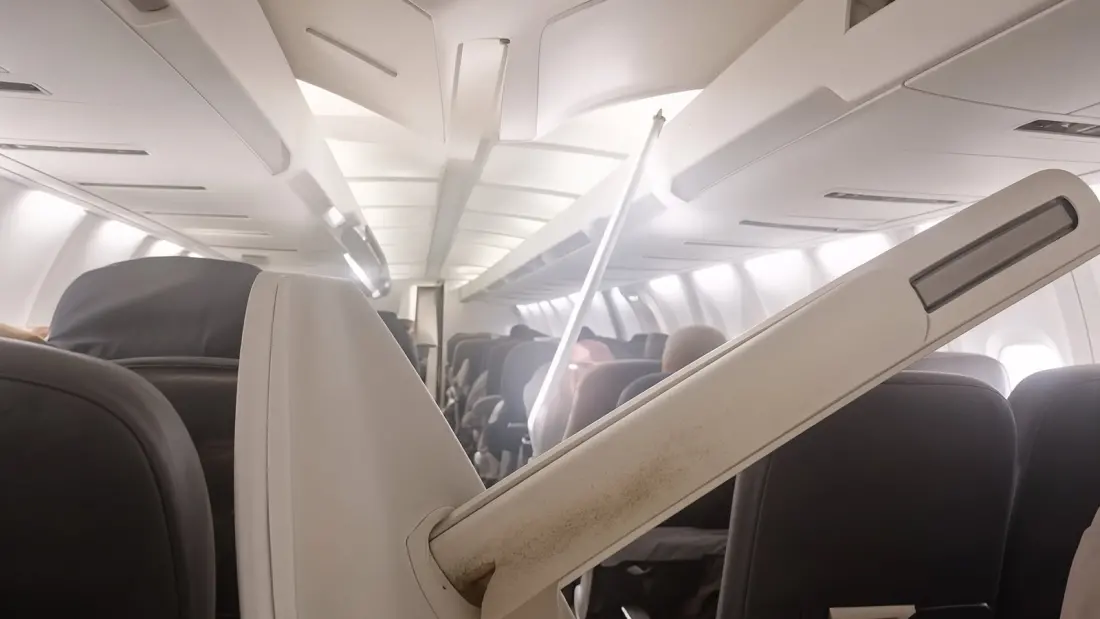
A domestic flight inside Iran turned into a scare on Monday when a long stretch of cabin ceiling broke loose and dropped across the seats. Passengers on Sepehran Airlines' route from Mashhad to Kermanshah grabbed the seatbacks in front of them as interior panels and overhead fittings sagged and fell into the cabin — all while the lights kept working overhead. The crew declared an emergency and returned to Mashhad. Nobody was hurt, according to local reports.
The aircraft involved appears to be a 30-year-old Boeing 737-300, registered EP-FSU, which first flew in July 1996. Local news accounts point to a burst tyre on takeoff followed by engine damage, and the runway used for the emergency landing was closed afterwards. Aviation writers note that heavy shaking — say, from an unbalanced rotating engine assembly or violent jolts from a damaged tyre — can overload the mounts holding interior panels in place. But the state of the cabin on the day also suggests underlying maintenance problems, and this wasn't the airline's only recent runway excursion: another Sepehran 737 ran off the runway at Mashhad on 25 August.
The timing is notable. On 8 September, six days before this flight, the US Treasury sanctioned Sepehran and the rest of Iran's airline sector, targeting the front companies and paperwork tricks Iranian carriers use to obtain aircraft and parts abroad. Washington has also shut down the remaining safety-of-flight pathway for some spare parts and adopted a presumed-denial stance on Iran-related licence requests, keeping exceptions only for urgent cases like risks to life. The sanctions are aimed at the regime's use of aviation to move weapons and personnel, not at passenger safety directly — and a policy change a week earlier didn't cause this incident. But modern airliners need a steady flow of parts, overhauls and technical support, and Iran has been running short for years. By late 2021, an Iranian airline association official said more than half the country's civilian fleet was grounded for lack of components.
Why should a traveller care? Because this is what fleet ageing and parts scarcity look like from seat 14A. If you're weighing travel to Iran, the practical reality is that domestic flights increasingly rely on decades-old aircraft with thinner maintenance support than you'd find almost anywhere else. That doesn't mean every flight is dangerous, but it does mean checking which carrier and aircraft type you're booking, considering overland alternatives for shorter hops like Mashhad–Kermanshah, and factoring in the wider picture: western governments currently advise against travel to Iran for most nationals, and the safety and licensing situation is deteriorating rather than improving. There's a reasonable argument — made even by sanctions critics — that tightly controlled access to genuinely civilian safety parts would make flying in Iran safer. Until then, stories like this one are worth treating as a signal about conditions on the ground rather than a one-off.
View from the Wing