
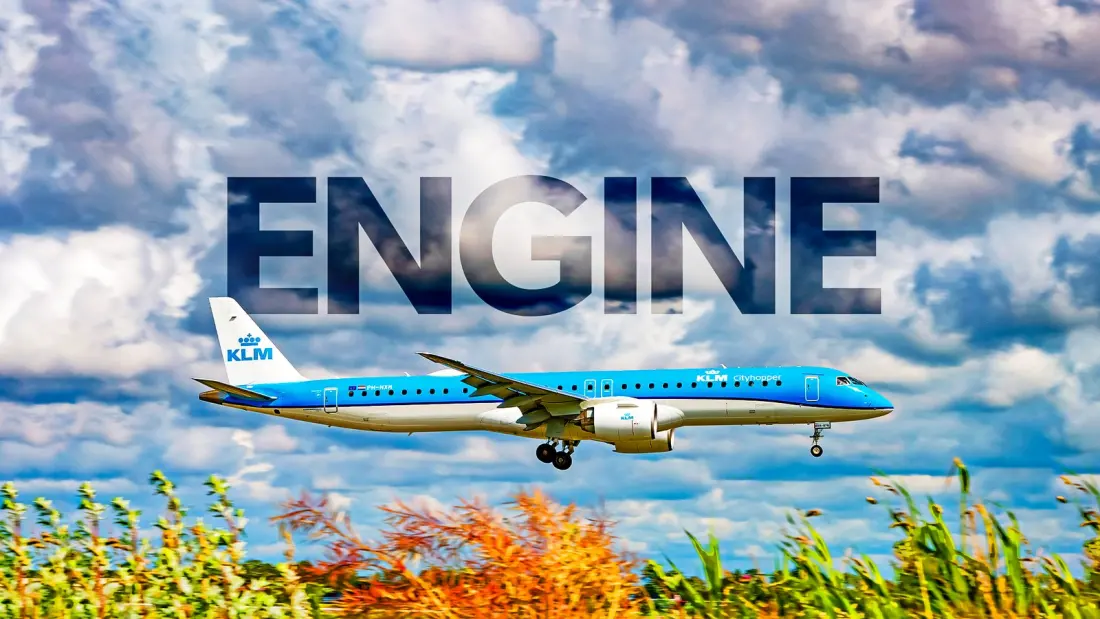
Most passengers boarding an Embraer E195-E2 will never notice the aircraft's strangest feature: a subtle upward bend in the wing where it meets the fuselage. That gull-wing shape exists for one reason — to squeeze a genuinely enormous engine under the wing of a jet that sits low to the ground.
The E195-E2 runs on two Pratt & Whitney PW1900G geared turbofans with 73-inch fans and a bypass ratio of 12:1. The engine it replaced on the first-generation E195, the General Electric CF34-10E, had a fan roughly 52 inches across. That 21-inch difference sounds modest, but on a regional jet whose fuselage already hugs the runway, it made the standard under-wing mounting impossible. During takeoff rotation, when the nose pitches up, an engine that large would have sat dangerously close to the tarmac.
Rather than compromise on engine size — the whole point of the new engine is efficiency — Embraer rebuilt the airframe around it. Engineers bent the inboard wing upward to raise the pylon mounting point, then added landing gear 20 inches taller than the previous model's. The taller gear uses a trailing-link design for softer touchdowns and retracts fully behind flush fuselage doors, which Embraer says saves about 1% in fuel burn compared with exposed gear pods. The company even built three separate bespoke wings for the three E2 variants instead of sharing one design.
The physics behind the big fan is simple: accelerating a large mass of air slowly wastes less energy than accelerating a small mass quickly. The PW1900G's gearbox lets the fan spin slowly for quiet running while the turbine spins fast for power, delivering Embraer's targets of 25% lower fuel burn per seat and the quietest noise signature of any narrowbody in production. The E195-E2's wingspan of 35.1 metres comes within 0.7 metres of an A320neo, on a much smaller airframe.
Gull wings have history — the WWII Vought F4U Corsair used a dramatic inverted gull for propeller clearance — but the E2's version is subtle enough that most flyers miss it. The real giveaway, per ground crews who handle both generations, is that the E2 simply sits higher on the ramp.
For travellers, this matters in practical ways: it's the jet behind many of today's longer thin regional routes, and its efficiency and low noise are part of why airlines can fly them economically. Aviation enthusiasts boarding an E2 should look out the window before takeoff — that gentle bend in the wing is rare engineering, done so passengers never have to think about it.
Story via Simple Flying.