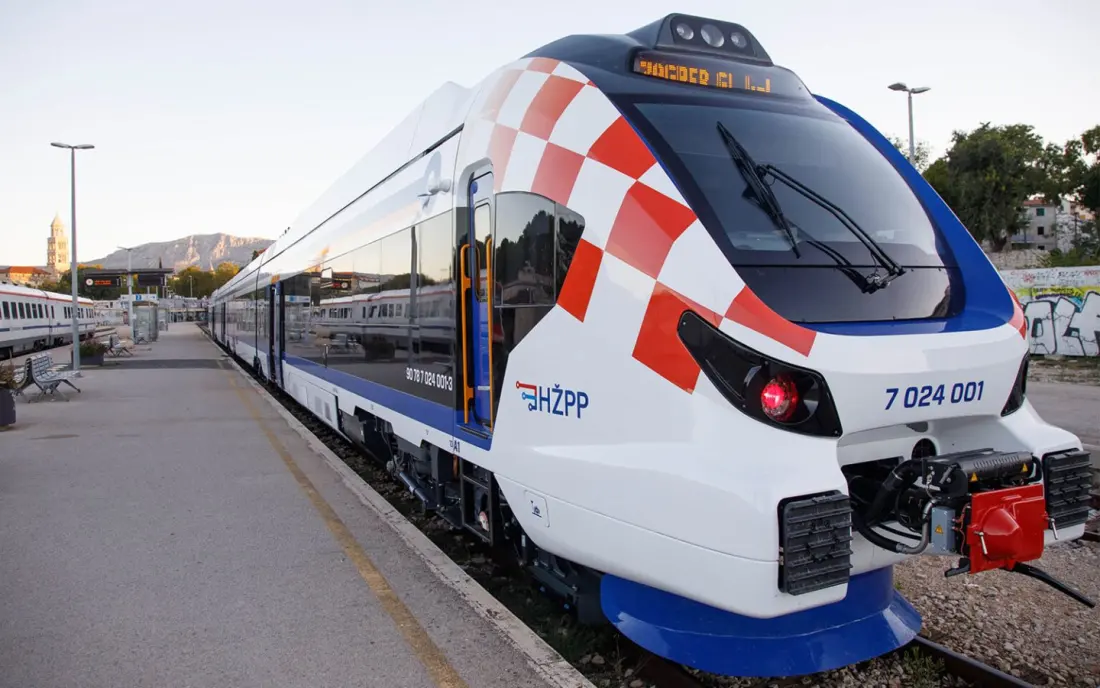
Croatian rail manufacturer Končar pulled off something of a coup at this year's InnoTrans in Berlin: its new train was parked in a more prominent position at the entrance to the fair's outdoor display than offerings from European heavyweights Alstom and Stadler. For a company celebrating its tenth appearance at the world's biggest railway trade fair, it was a statement of intent.
The star of the show is Končar's new bimodal electro-diesel train, which made its global premiere at the event. The idea behind it is simple: one train, two power sources. It switches seamlessly between electric and diesel traction, meaning it can run uninterrupted across both electrified and non-electrified parts of the network — a genuine advantage on long routes where electrification is patchy. Operators can also couple up to three units and run them from a single driver's cab, so capacity can flex with demand.
Passengers get perks too: a first-class section, a catering zone and full accessibility for people with reduced mobility. If that sounds familiar to anyone who has travelled Croatian rails recently, it should — a train from this series entered regular service on the Zagreb to Split route just a week before the Berlin debut, in partnership with operator HŽ Passenger Transport. It was the 70th train Končar has delivered to the carrier, a milestone in the ongoing modernisation of Croatia's railway system.
The Berlin debut also marks Končar's fourth propulsion platform developed and built in Croatia, following electric, diesel-electric and battery trains. Two years ago the company presented a battery train at InnoTrans that went on to become the first of its kind in commercial use in Europe.
The fair itself is breaking records as it turns 30. More than 3,170 exhibitors are attending — roughly 200 more than the previous record year in 2024 — filling all 42 halls of the Berlin Messe complex, some 200,000 square metres in total. The outdoor display covers 20,000 square metres with 3,500 metres of track, where 113 vehicles from 17 countries are on show. Organisers are hopeful of beating 2024's attendance figure of around 170,000 visitors.
Why should holidaymakers care? Because the trains being showcased in Berlin are the ones increasingly running on routes travellers actually use. The Zagreb–Split line is one of Croatia's most scenic and most trafficked summer corridors, linking the capital with the Dalmatian coast, and newer rolling stock means more comfort, better reliability and accessibility on a journey that takes the best part of a day. Končar's push into bimodal technology also suggests more seamless services on lines that were previously limited by patchy electrification. For anyone planning to see Croatia by rail rather than by car or budget flight, the national network is quietly becoming a far more attractive option — and this time, the country's own industry is the one driving that change. Total Croatia