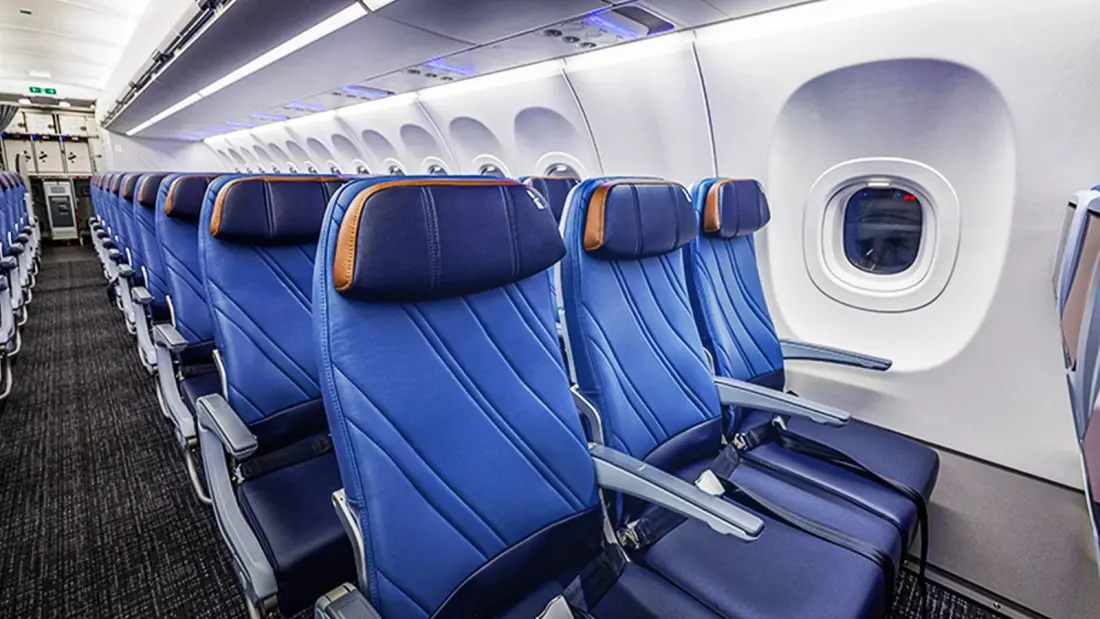
Paying for a better seat used to be a simple two-option decision: stay in standard Economy or jump to Premium Economy. In 2026 there's a crowded middle ground, and knowing when the cheap option beats the full cabin upgrade can save serious money.
The case for extra-legroom Economy comes down to targeting. If what actually ruins a flight for you is cramped knees, extra pitch delivers the one improvement you notice most — without funding upgraded meals, amenity kits or priority services you may not want. The data suggests airlines have spotted a real market: an Upgraded Points analysis of over 5,000 flights on America's ten busiest domestic routes found average fares of $188 where pitch sat at 28–29.9 inches, $225 at 30–30.9 inches, and $276 at 31–33 inches. That's an $88 spread tied purely to legroom. Meanwhile, 46% of frequent flyers surveyed called legroom very or extremely important when booking Economy, and 39% had already paid extra for it.
But the surcharge isn't standardised. Dynamic pricing means the same five extra inches can cost $20 on one route and, in Southwest's case, as much as $319 on some September 2026 itineraries — brutal economics on a short hop. Flight length, aircraft configuration and the exact seat specs all matter. Watch out for 'preferred' seats that buy you a better location rather than actual space, and recheck the seat map before departure in case of an aircraft swap; airlines fly the same model in several different layouts.
Qatar Airways shows how blurry the line has become. It flies nine second-hand Boeing 777-300ERs — six ex-Cathay Pacific, three ex-Virgin Australia — that kept their original cabins. The former Cathay Premium Economy seats are now sold as Economy 'Comfort+', with 38 inches of pitch versus roughly 32 in standard Economy, plus a wider seat and extra recline. The ex-Virgin planes go further: rows 15–17 are the old 24-seat Premium Economy cabin, offering about 41 inches of pitch, 19.5 inches of width and footrests — sold at an Economy-seat surcharge, with Economy meals and service. For pitch-focused passengers, that's a Premium Economy chair at a fraction of the usual cabin price.
Premium Economy still wins in specific scenarios. On sectors of eight hours or more, especially overnight, seat width, recline and a footrest matter as much as pitch when you're trying to sleep. Full Premium Economy may also bundle better food, priority boarding, extra baggage and an amenity kit. And always compare total fares, not just the seat fee: if extra legroom costs $200 and Premium Economy is only $250 more overall, the gap is small enough to flip the maths.
The practical rule of thumb: under two hours, skip big surcharges; two to four hours, a modest fee for pitch is reasonable; four to eight hours, it's genuinely attractive if space is your priority; overnight and long-haul, lean towards a real Premium Economy recliner. Your height and whether you plan to sleep should drive the decision — not the marketing label.