Most Singaporeans can recite their IC number without blinking, but few know what that opening letter means. Turns out the "S" isn't short for Singapore — it's simply the 19th letter of the alphabet, assigned to anyone born in the 1900s. Babies born from the 2000s onwards got the "T". So if you ever meet someone with a "U" number, they're from the future.
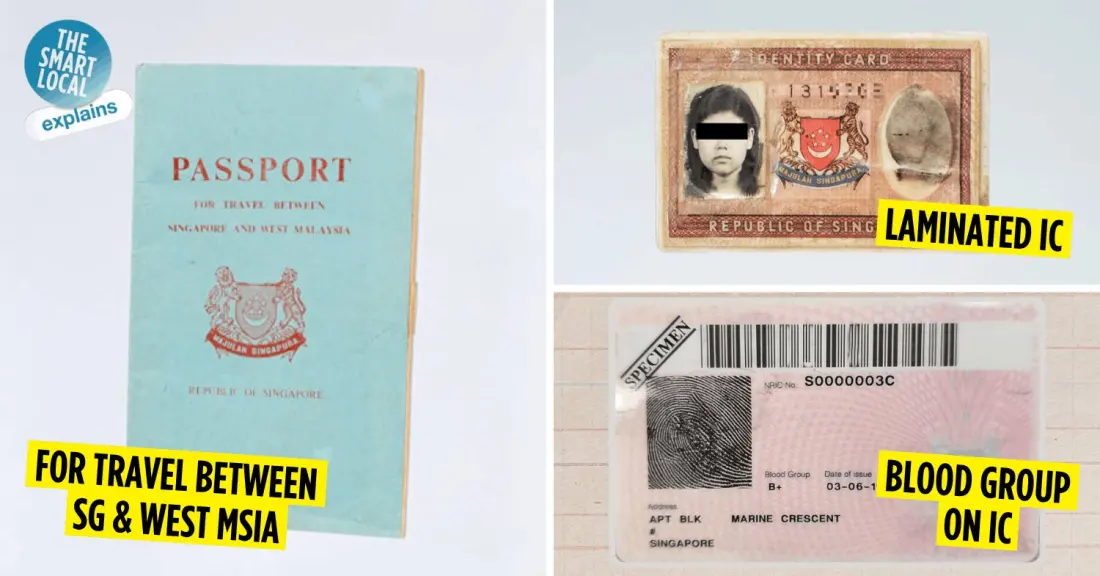
That's just one of the quirks in the history of Singapore's identity and travel documents, and it's a surprisingly good story. Before 1968, Singaporeans juggled two different numbers — one on their birth certificate, another on their IC. The first laminated ICs arrived in 1966, complete with a thumbprint, and the very first number issued, S0000001/I, went to the nation's first President, Yusof Ishak. In 1991 the flimsy laminated cards were swapped for tough polycarbonate versions with laser images and engraved barcodes — and ICA officers famously trekked out to bedbound residents and even Pulau Ubin to re-register everyone in person. A stranger quirk: from 1985 to 2002, your blood group was printed right on the card, until faster lab testing made it redundant.
The passport's history is just as interesting. Singapore issued its first provisional passport a mere eight days after independence, on 17 August 1965. For decades there was also a separate Restricted Passport used only for hopping between Singapore and West Malaysia, which quietly died out in 1999 once demand dried up.
The modern passport hides some clever anti-forgery tricks too. Tilt it under light and you'll find an orchid-shaped design that shifts with the angle, a multiple laser image shaped like the Singapore map, raised tactile patterns, and a window lock feature where your photo flips between positive and negative. It's one reason the little red book consistently ranks among the world's most powerful passports.
Clearing immigration is also changing fast. Since September 2024, all Changi terminals use facial and iris biometrics for passport-less clearance — though you still legally need to carry the physical booklet. And since March 2022, inked passport stamps are gone at Singapore checkpoints, replaced by electronic Visit Passes. It's a win for speed, but a small loss for anyone who collects chops as souvenirs of their trips.
One last bit of good news: passports issued from October 2021 are valid for 10 years instead of five for citizens aged 16 and up, so that $70 renewal fee now stretches a decade further.
Why does any of this matter to travellers? Because your passport is the one thing you carry on every single trip, and knowing its validity rules, security features, and how clearance works at Changi can save you real headaches — whether that's renewing early enough, keeping the booklet handy despite biometric gates, or explaining to a confused friend why they didn't get stamped on arrival.