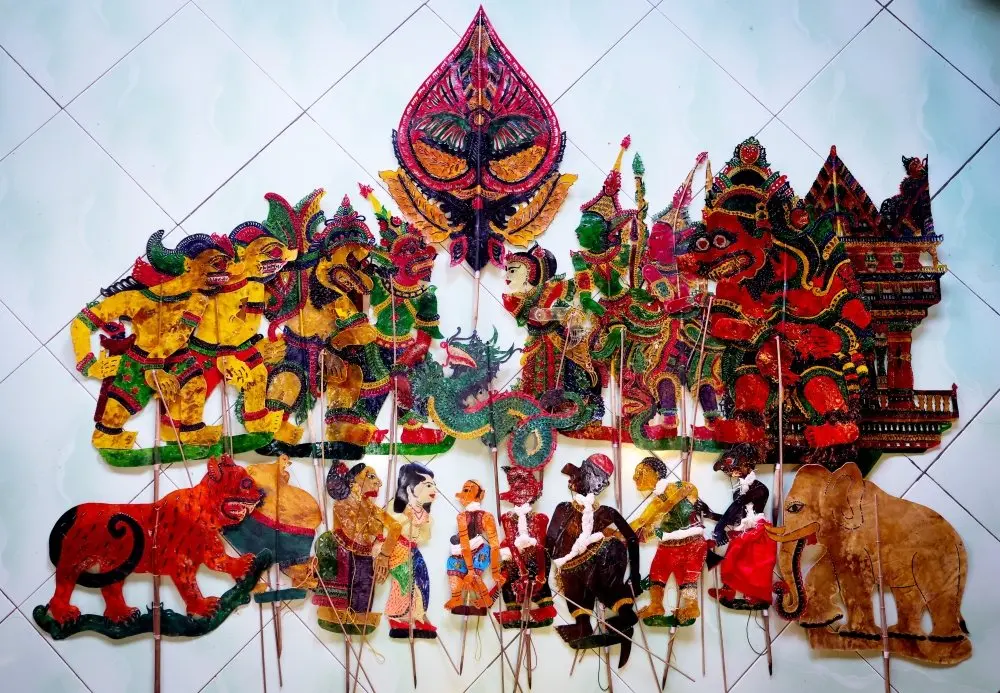
In a workshop in Kok Lanas, just outside Kota Bharu in Malaysia's Kelantan state, Che Ann sits with a metal hammer and a set of nails, punching thousands of holes into a sheet of cowhide. What emerges is a wayang kulit puppet — one of the intricately carved figures that cast their shadows on a white screen during Kelantan's traditional shadow puppet theatre.
Che Ann, a 58-year-old Peranakan Chinese practitioner whose full name is Kang Boon Ann, has spent more than three decades making puppets and performing as a tok dalang, the puppeteer who brings the whole show to life. His family performs with him under the Sri Cindayu Wayang Kulit Association, and he's one of only a handful of people still actively keeping the art form going in the state.
The craft is slow. Fresh cowhide is sun-dried for around a month, then scraped by hand and sketched before the punishing part begins: hammering perforations that let light pass through and project fine details — facial features, costumes, accessories — onto the screen. Simple village characters take a few hours each, but heroes like Seri Rama, or elaborate figures like banyan trees and palaces, can eat up a full week. Machines could speed things up, Che Ann says, but the precision and beauty of hand carving can't be replicated.
Tradition governs nearly everything. Of the more than 100 characters in the wayang kulit world, each has fixed colours and meanings: Seri Rama must be green, his brother Laksamana red. Deviate, and both audiences and fellow practitioners will call it out.
Interestingly, while demand for performances has cooled, the puppets themselves sell steadily. Che Ann's best-sellers are Seri Rama, Sita Dewi, Hanuman Kera Putih and Rawana, bought as collectables or décor — with orders arriving from Singapore and even Switzerland. Large pieces go for around RM600, others from RM300 to RM550. He knows they'd fetch over RM1,000 in Kuala Lumpur's Central Market, but deliberately keeps prices low so the heritage stays accessible.
There's a quiet problem, though: sourcing good cowhide. Modern commercially fed cattle produce fatty, dull hides that are harder to carve, and thick-skinned imported breeds like Charolais dominate the market. Locally grazed cowhide has become so scarce it can take a month to obtain a single piece.
For travellers, this is a rare chance to see a living craft rather than a staged show. Che Ann runs puppet-making workshops at schools, universities and cultural agency programmes, and visitors to Kelantan — a state with its own distinct Malay culture, cuisine and crafts — can encounter wayang kulit as it actually exists: patient, demanding and deeply personal. As he puts it, you can't love what you don't know — and once you've tried hammering the nails yourself, the shadows on the screen look very different.