
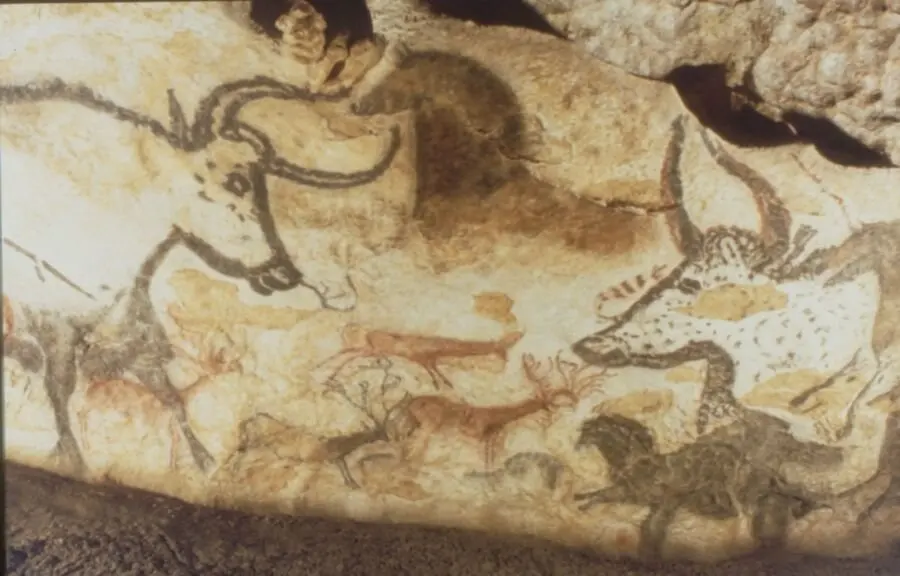
Deep under southwest France lies one of the oldest art collections on Earth. The caves of Lascaux were painted around 18,000 BC by Cro-Magnons — fully modern humans, not the grunting cavemen of cartoons — and the work still astonishes. Bulls, horses, deer, bears, wolves and cats cover the walls, some figures standing 16 feet tall, alongside human handprints and even extinct species like the woolly mammoth.
What makes the paintings remarkable isn't just their age — roughly four times older than Stonehenge or Egypt's pyramids — but their sophistication. This was serious engineering. The artists hauled minerals into cold, pitch-black limestone caverns they didn't live in, ground pigments with mortar and pestle, and built scaffolding to reach the ceilings. The main chambers run longer than a football field. They sketched outlines from dotted guides, painted with animal-skin sponges, and even used a spray-paint technique, blowing pigment through hollow bones. Wavy black outlines gave the animals a sense of motion.
Imagine the unveiling: a small group led by torchlight into an echoing underground chamber, someone lighting the lamps, and suddenly the herd flickering to life in the darkness — essentially a prehistoric cinema. Why they did it remains a mystery. Theories range from hunting magic (painting the animals to guarantee the supply of game) to ritual worship to the simpler idea that these caverns were Europe's first art galleries, built for an audience. Nobody knows, and that unknowable quality is part of the pull.
Here's the practical catch: the original cave has been closed to visitors for decades, since carbon dioxide from human breath was damaging the paintings. But you're not missing out. Two meticulously crafted replicas, Lascaux II and Lascaux IV, sit adjacent to the original site and recreate the experience down to the painted figures in the dim light. Lascaux IV, the newest of the centres, uses modern exhibition design to put the artwork in context, so you come away understanding both the art and the people behind it.
For travellers, this is one of those rare sights that connects you directly to something far older than any cathedral or castle. The Dordogne and Vézère valley region around the cave is packed with other prehistoric sites, making it easy to build a few days around the theme. Whether you come away feeling kinship with the painters or awe at how alien their minds were, the caves tend to leave a mark. Twenty thousand years on, the mystery is very much intact — and very much worth the detour.