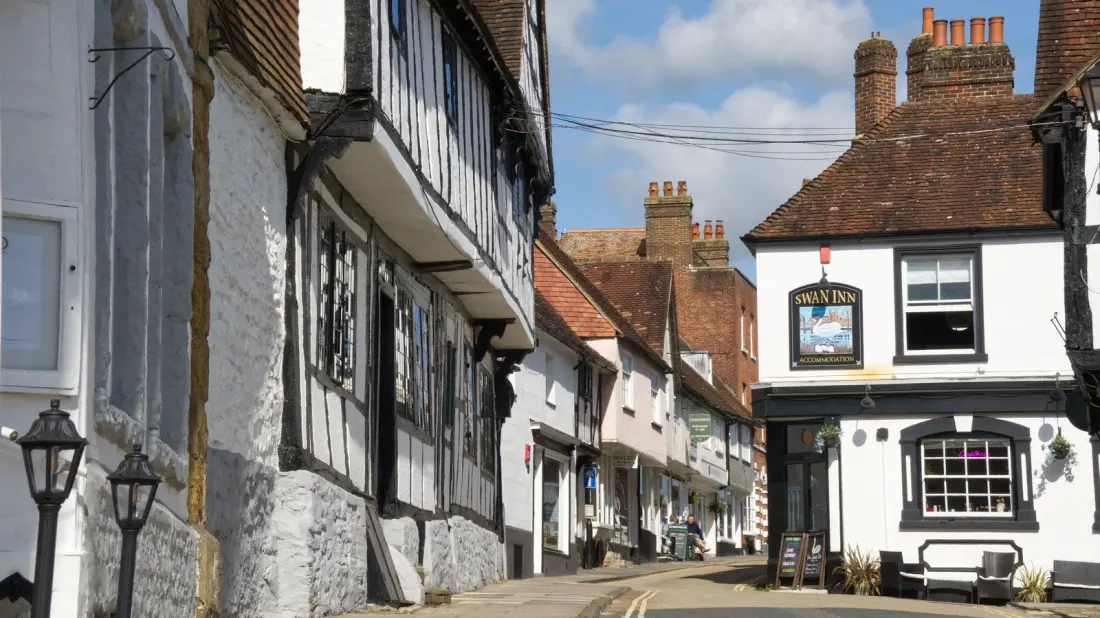
Some of England's best small towns hide inside its national parks, and Midhurst in West Sussex might be the best example. This market town of timber-framed buildings sits on the River Rother in the middle of the South Downs National Park, surrounded by rolling chalk hills, ancient hedgerows, and heathland that flushes purple in late summer.
Midhurst looks the part. Many of its buildings date to the 16th century, and the streets mix Tudor, Georgian, Victorian and Edwardian architecture. Independent shops line the centre, including J E Allnut & Son, a clock and jewellery shop run by horologist Geoff Allnut, and Wheelers Bookshop, a cosy spot to shelter from rain. Refuel at Gartons Coffee House, or settle into the Bricklayers Arms for a Sunday roast and local ale. Staying overnight? The Spread Eagle is a 15th-century coaching inn reputed to have hosted Queen Elizabeth I.
History runs deep here. The ruins of Cowdray House, once a grand Tudor home visited by Henry VIII and Elizabeth I, are perhaps best known for a stranger connection: Guy Fawkes worked there as a footman before the Gunpowder Plot. Both Cowdray and Capron House, where H.G. Wells went to school, feature on the self-guided 1.8-mile Midhurst Heritage Trail, which ends at the remains of Midhurst Castle, an Iron Age fort on St Ann's Hill looking over Cowdray Park — the self-declared home of British polo.
The town's real asset is what surrounds it. The South Downs only became a national park in 2010, making it the newest in the UK, and it's built for slow exploration rather than box-ticking: over 2,000 miles of rights of way cross its valleys, woods and coastline. The 100-mile South Downs Way, the only national trail lying entirely within a national park, runs from Winchester Cathedral to Eastbourne beach, passing five national nature reserves. The trail comes within about three miles of Midhurst at Cocking, making the town a handy base. Closer still is Levin Down nature reserve, five miles away, where chalk grassland blooms with wildflowers each spring, drawing red kites, buzzards and butterflies. For something different, the 65-mile Serpent Trail crosses sandy heath near Iping and Stedham Commons, home to Dartford warblers, adders and lizards.
One practical catch: Midhurst has no railway station. Trains run from London to Chichester, about 12 miles south, where you can pick up a bus. Driving the roughly 55 miles from London is easy on paper, but expect traffic heading out of the city.
Midhurst suits travellers who like their holidays gentle and atmospheric — walkers wanting a comfortable base for the South Downs Way, history buffs chasing Tudor ghosts, or anyone after pubs, bookshops and countryside in one neat package.