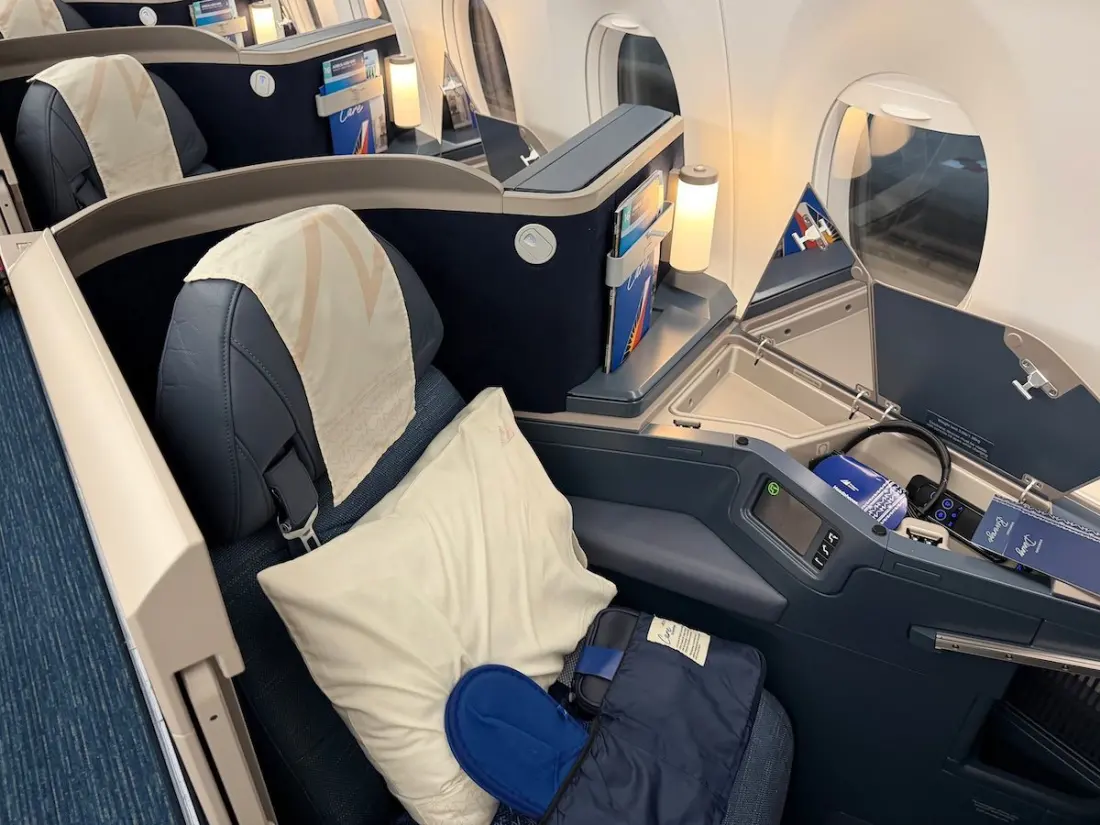
Philippine Airlines has been rolling out its new Airbus A350-1000, and on the nearly 12-hour flight from Manila to San Francisco, one reviewer got a first proper taste of the airline's new-generation business class. The verdict: a big leap forward for the flag carrier, even if it doesn't quite match the region's elite.
The hard product is the standout. The A350-1000 flies with Collins Aerospace Super Diamond suites that have doors — essentially the same setup you'll find on Etihad's A350-1000s — and it ranks among the better business class seats flying today. Seat tech is well covered too: Bluetooth audio pairing, wireless charging, USB-A, USB-C and AC power. Bedding is genuinely good, with a thick mattress pad, plush pillow and a cozy blanket, plus a L'Occitane amenity kit and slippers (no pajamas, though).
Service moved at pace. The first meal was fully cleared within 75 minutes of takeoff, which matters on a departure after 11pm when most people want to sleep. Food presentation was attractive, with nice tableware, and quality was decent rather than spectacular — the Filipino dishes beat the Western ones, as you'd probably expect.
Then there's the price. Philippine Airlines undercuts its competitors on this route significantly, and that value equation is the whole argument for booking it. You're getting a globally competitive seat for less than you'd pay on most Asian or US carriers.
The frustrations are the kind that sting because they're avoidable. The aircraft has Viasat Wi-Fi in theory, but it didn't work at all during the entire flight. There are no individual air nozzles, although the cabin was kept comfortably cool. The crew was friendly but passive — don't expect proactive refills or check-ins. The menu advertises cappuccinos on the A350, but crews say they're not actually offered. The wine list was underwhelming, and the lavatory occupancy indicators on the bulkhead were stuck on green the whole flight.
The reviewer's overall take: he'd absolutely fly it again if the price or schedule worked, with one big caveat — transiting Manila airport, which he found painful. Philippine Airlines isn't a first-tier Asian airline yet, but with this pricing, it doesn't need to be.
Why should travellers care? If you're flying between North America's west coast and the Philippines, or using Manila as a jump-off point for Southeast Asia, this is now one of the better-value ways to do it flat in a lie-flat suite. You trade some polish — spotty Wi-Fi, softer service instincts, mediocre wine — for a substantial saving. For anyone who books business class on value rather than bragging rights, that trade is increasingly easy to make. And the fixes the airline needs (working internet, a working cappuccino machine) are cheap ones, so this product could quietly get even better.