If you fly with a portable charger, get ready for a shake-up. From January 2027, the International Air Transport Association (IATA) is rolling out new guidance that will change how nearly every airline handles lithium batteries in the cabin — and some carriers are already enforcing the new rules.
The timing isn't random. The US Federal Aviation Administration has logged 58 incidents of smoke, fire, or extreme heat from lithium batteries on commercial flights so far in 2026, including an August laptop fire on an American Airlines flight from Atlanta to Dallas that reportedly burned up to five people. These fires are uniquely nasty: the chemical reaction produces its own oxygen, which feeds the flames.
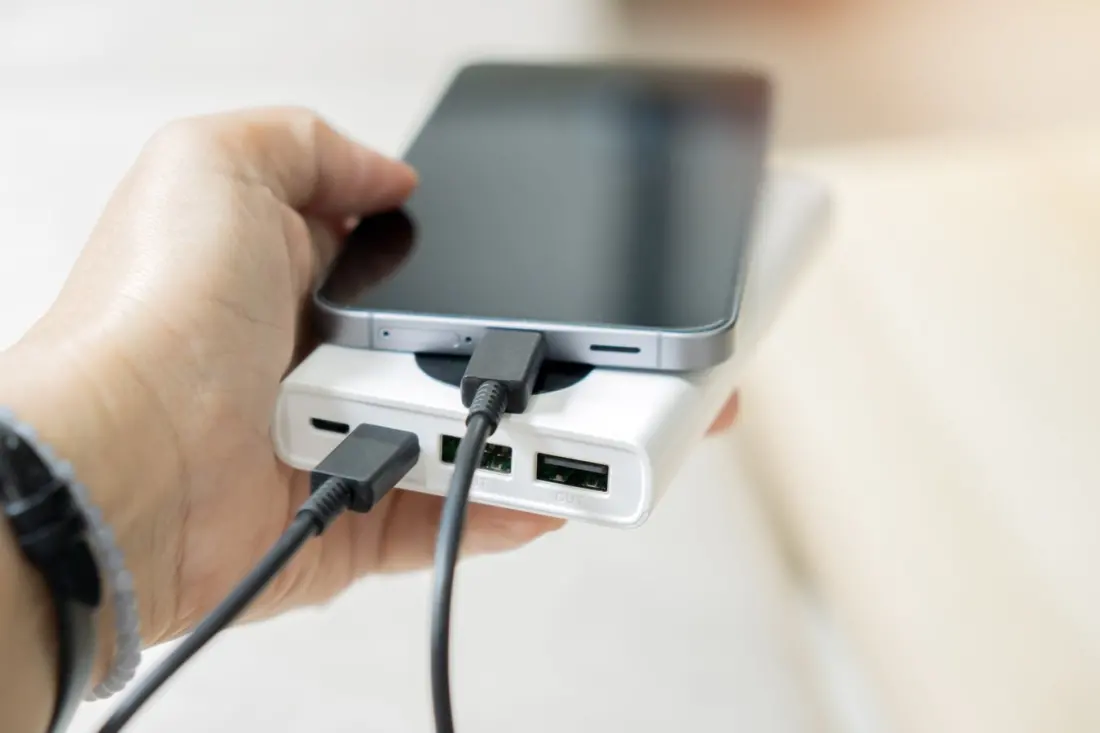
What changes in January 2027? Three things, applying to virtually all airlines worldwide. You won't be able to recharge a power bank during the flight. You won't be able to use one to charge your other devices in flight. And you'll be capped at two power banks, which must travel in the cabin — never in checked luggage, a rule the TSA already enforces. Surveys suggest roughly half of passengers still don't know batteries can't go in checked bags at all, so expect extra announcements at the gate.
Several airlines aren't waiting for the deadline. Delta and American have already adopted the two-battery limit (American caps capacity at 100 watt-hours), while United allows two batteries between 100Wh and 160Wh, provided they stay at your seat rather than in the overhead bin. Southwest and Emirates have gone stricter still, allowing just one power bank per person. And a string of European carriers — Lufthansa, Swiss, Austrian, Brussels Airlines, and Eurowings — already ban using power banks onboard entirely, a prohibition all major airlines are expected to adopt.
The FAA, for its part, hasn't matched the global standard: it doesn't limit device counts or ban chargers from overhead bins. That gap is why the industry is moving on its own.
If you travel with multiple batteries — photographers and videographers, this means you — check your specific carrier's dangerous goods page before you pack, since airlines set their own rules beyond the IATA baseline. Capacity matters too: most consumer power banks sit comfortably under 100Wh, but chunky laptop-grade packs may not. And if a battery looks damaged or feels uncomfortably hot, it's a failure waiting to happen — dispose of it. United's advice is the simplest rule of thumb: if you're unsure about a battery, leave it at home.
For travellers, the practical upshot is planning ahead: top up your devices before boarding, since in-flight charging will no longer be an option, and double-check the watt-hour rating printed on your charger before you fly.