
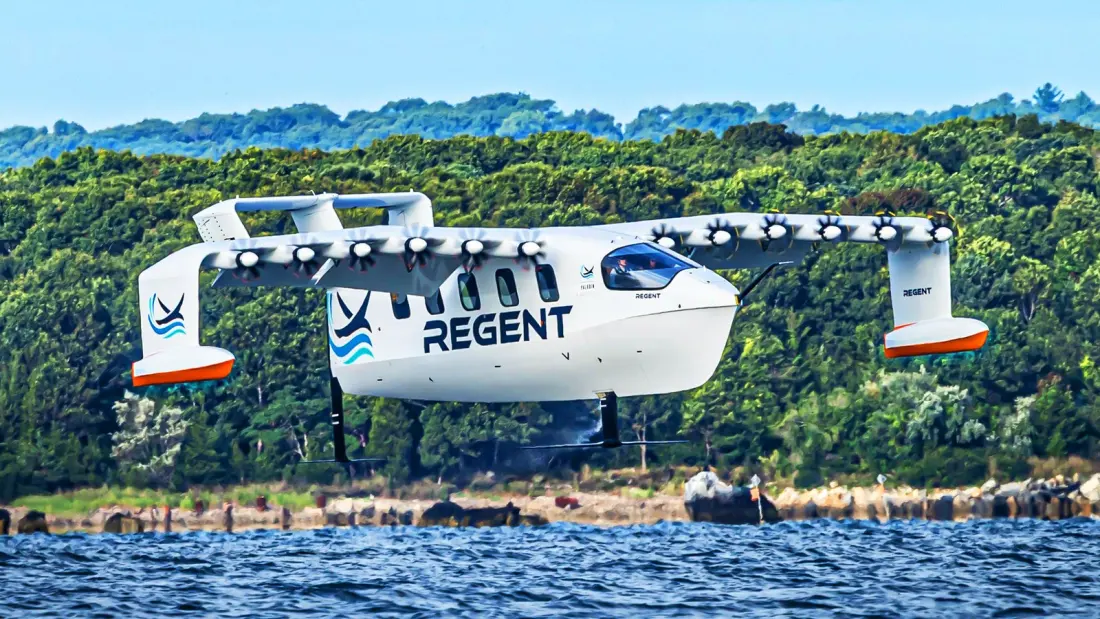
Regent Craft's Viceroy Seaglider just pulled off something new: on 2 September 2026, the prototype completed its first crewed flight over Narragansett Bay in Rhode Island, travelling 1,956 feet at 33 feet above the water for 30 seconds with two captains aboard. It's now the largest all-electric wing-in-ground-effect craft ever flown with people on it. And legally speaking, it's a boat.
That classification is the interesting part. Seagliders exploit ground effect — extra lift and less drag when a wing skims just above a surface — to fly within one wingspan of the water. They operate in three modes: floating on the hull at the dock, rising on hydrofoils, then flying. Because they can't climb out of ground effect, the IMO/ICAO rules put them in 'Type A', which makes the US Coast Guard the primary regulator rather than the FAA. Congress formalised this in the 2024 FAA Reauthorization Act, which keeps operators of such craft from being regulated as air carriers. Practical upshot for passengers: no airport-style security and check-in, you board like a ferry.
The commercial Viceroy carries 12 passengers and two crew, cruises at around 160 knots (roughly 180 mph), and has a range of about 160 nautical miles. Regent promises generous legroom, big windows and a quiet ride. The launch customer is The Twenty Five, a luxury coastal travel membership operator, with orders for up to 60 vessels. Regent opened its first manufacturing facility at Quonset, Rhode Island, in June.
There's a serious military side too. A hybrid Viceroy variant stretches range to 1,400 nautical miles with a 3,500 lb payload, and Regent is courting the Pentagon — it holds a $15 million Marine Corps Warfighting Lab contract and a partnership with US Special Operations Command. The pitch: a craft that flies below line-of-sight radar, takes off and lands at sea in waves up to 5 feet, and moves cargo or evacuates casualties along contested coastlines without needing runways. China is developing similar vehicles, so this is very much a race.
For travellers, the near-term appeal is coastal hops — think quick, quiet, low-friction links between waterfront destinations where a ferry takes hours and a flight means an airport. Commercial service hinges on the ongoing sea trials and certification, so don't book yet, but this is one of the more plausible new ways to travel a coastline taking shape right now.