
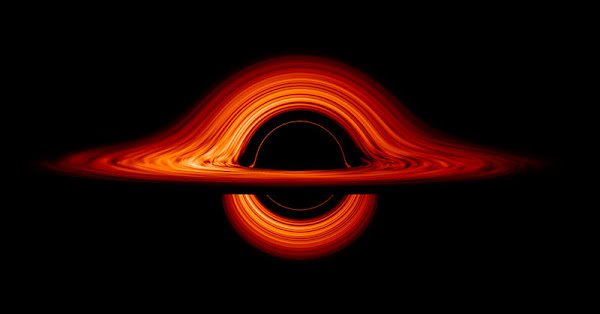
Long before anyone had heard of black holes, a country clergyman in Yorkshire worked out the basic idea at his rectory. John Michell, rector of St Michael's Church in Thornhill near Leeds from 1767 until his death, presented a paper to the Royal Society in 1783 proposing that some stars could be so massive that their own light could not escape. He called them "dark stars" — and modern physicists recognise them as black holes in all but name.
Michell reasoned from Newton's picture of light as tiny particles. If gravity pulls on matter, it should pull on light too. He calculated that a star with the Sun's density but roughly 500 times its radius would have an escape velocity exceeding the speed of light — invisible, yet still exerting gravitational pull. Even smarter, he suggested how to find one: watch for visible stars moving as though tethered to an unseen companion. That is essentially the same technique astronomers use today to identify black hole candidates.
His Newtonian maths produced a boundary identical to the Schwarzschild radius that Karl Schwarzschild derived from Einstein's equations in 1916 — different physics, same number. But Michell's idea sank, largely because the corpuscular theory of light it relied on fell out of fashion during the 19th century. By the time relativity revived the concept, his paper had been forgotten for generations.
The dark stars were only one string to his bow. Michell, born in 1724 in Eakring, Nottinghamshire, and educated at Queens' College, Cambridge, also published an eighty-page treatise on making artificial magnets in 1750, established that earthquakes travel as waves through the Earth after the catastrophic Lisbon earthquake of 1755 (work that earned him Royal Society election in 1760 and laid the groundwork for seismology), and in 1767 became the first scientist to apply statistics to star positions — proving that groups like the Pleiades were physically bound rather than chance alignments, the first evidence for binary stars and clusters. He even built the torsion balance later used by Henry Cavendish in 1797–98 to weigh the Earth, dying before he could run the experiment himself.
For travellers, this is a lovely detour for anyone exploring West Yorkshire. Thornhill is a short drive south of Leeds and Wakefield, and St Michael's Church — where Michell served and worked for the rest of his life — still stands as a quiet piece of scientific history. Pair it with a day in Leeds or a visit to Yorkshire's industrial heritage sites, and you can stand in the parish where one of the 18th century's sharpest minds quietly anticipated one of the universe's strangest objects. Few historical footnotes come with a better conversation starter.