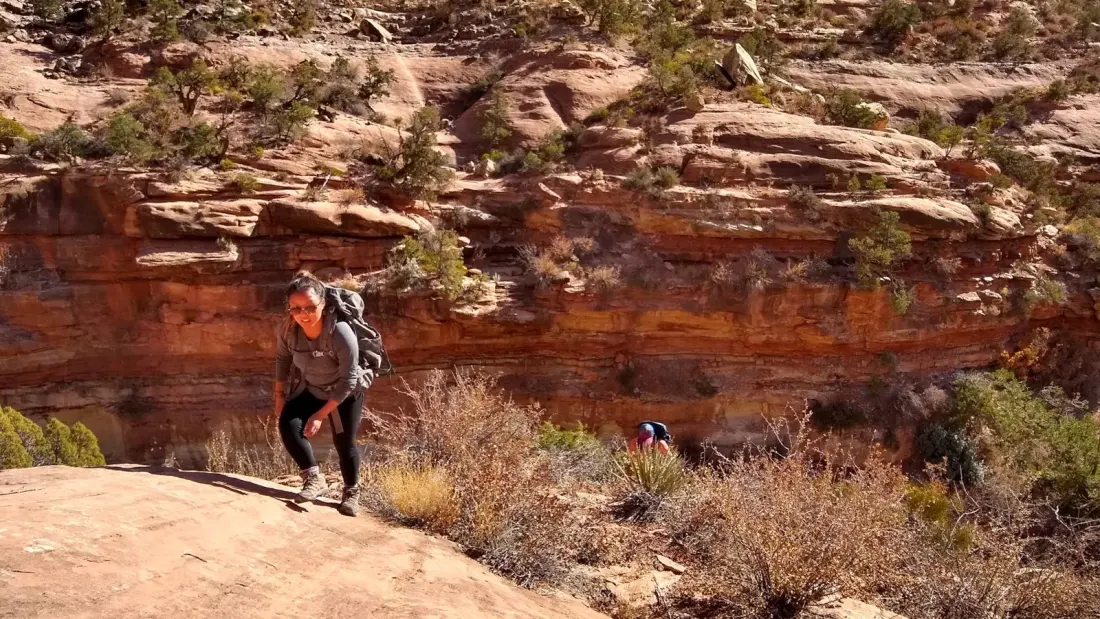
A long hiking day can rack up thousands of steps, and if your form is slightly off, your body repeats that mistake over and over until something starts to ache. Sore knees, cranky hips and lower-back pain on the trail often trace back to small habits that only become obvious once fatigue sets in. The good news: each one has a simple fix you can practise at home or on a shorter walk.
First, knees caving inward. As you tire, one or both knees may drift inwards with each step, a control problem rather than a technique one — the muscles above and below the joint simply run out of strength. The recommended drill is the step-down: stand on a 4- to 6-inch step on one foot, flex the other foot upward, and slowly lower that heel to tap the floor, keeping hips level and knee tracking over your second toe. Do two to three sets of six to 10 reps per side, using a wall or countertop for balance if needed, and raise the step by 2 to 4 inches as control improves. If your knee starts collapsing in when you're tired, slow the movement down rather than rushing through it.
Second, over-striding. When hikers try to speed up, or on descents, the foot tends to land well ahead of the body. That forces tendons and ligaments to act as brakes on every step, instead of letting your skeleton absorb the impact — a fast track to soft-tissue injuries. The fix is short, quick steps: keep your feet landing underneath you and bump up your cadence. Practise it in short bursts of 30 to 60 seconds during a hike until the shorter stride becomes automatic. A useful mental cue: "feet underneath me," not reaching forward.
Third, hip instability. Hiking is essentially single-leg work on repeat, and when your hips tire, your pelvis can start dropping side to side or your torso sways excessively over the planted leg. You'll feel it most stepping over rocks, climbing, or crossing uneven ground, and it often shows up as hip or lower-back ache. The hip airplane exercise targets this: standing on one slightly bent leg near a support, hinge forward with a flat back, then slowly rotate your torso over the standing leg by lifting the raised hip toward the ceiling, and rotate back. Range of motion matters less than keeping your pelvis steady without losing balance.
Why should holidaymakers care? Because a rolled ankle or a knee that gives out at kilometre eight can end a trip early. Whether you're planning a hut-to-hut trek in the Alps or a section of a long-distance trail, a few weeks of these drills before you travel — and reminders to shorten your stride on descents while you're out there — are far cheaper than a physio bill mid-holiday. Even if you're a casual day-hiker, building knee and hip control now means smoother miles later, wherever your boots take you.