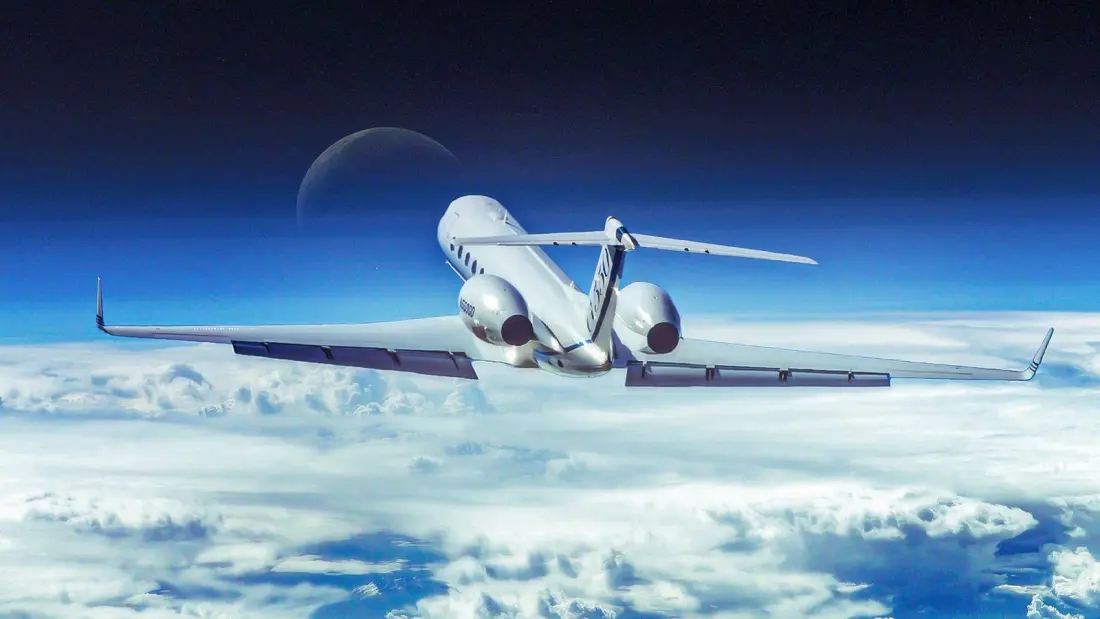
At 51,000 feet — ten miles up — the sky turns from blue to deep indigo and the horizon visibly curves away. That view is off-limits to ordinary airline passengers: commercial jets top out between 31,000 and 41,000 feet, and only ultra-long-range business jets like the Gulfstream GVI and Bombardier Global 7500 are built to cruise in the stratosphere's low-traffic band.
The visual difference is stark. With nearly all the water vapour and dust left far below, the sky darkens toward black at the top of the windscreen, the sun becomes a harsh white disk, and the atmosphere appears as a thin blue shell hugging the planet. Pilots can compare the horizon against the aircraft's glare shield and watch it sit visibly below eye level — with haze and refraction stripped away, mountain ranges and coastlines hundreds of miles away show up with sharp edges. The visible horizon stretches roughly 276 miles from the cockpit.
There's a practical payoff too. Even severe thunderstorms usually top out between 35,000 and 45,000 feet, so a jet at flight level 510 glides over the weather that forces airliners into bumpy detours. There's almost no other traffic up there either, so crews routinely get direct routings that cut hundreds of miles off a trip — a far cry from the zig-zagging airways commercial aircraft must follow.
The physics that makes this possible is unforgiving. Air density at that height is about 20% of sea level, and the gap between stall speed and the speed where the aircraft hits Mach buffet — the so-called coffin corner — can shrink to five or ten knots. Crews rely on precision auto-throttle systems holding a constant Mach number, because a sharp turn or a temperature shift can push the jet out of its envelope. The engines, meanwhile, love the cold: at roughly -56.5°C above the tropopause, turbofans like the Rolls-Royce BR710 run at peak efficiency, which is how a Gulfstream V manages nearly 6,500 nautical miles of range.
Passengers notice the comfort as much as the calm. The pressurised cabin can hold an effective altitude of 3,300 to 4,800 feet — compared with around 8,000 feet on a standard airliner — which means better oxygen saturation on arrival and less of the drained feeling after a long-haul flight. Safety systems match the hostile environment: in a rapid decompression, a pilot's time of useful consciousness at 51,000 feet is under nine seconds, so these jets carry automatic emergency descent modes that can dive to breathable altitudes on their own.
The last airliner to offer this view to paying customers was Concorde, which cruised near 60,000 feet for 27 years before fuel burn, sonic boom rules and maintenance costs grounded it. Today's airlines have optimised for fuel efficiency in the denser air lower down, so the flight level 500-510 band remains a near-empty club for private jets. For travellers with the budget, it's the closest thing to a spaceflight available without leaving the atmosphere.
Story via Simple Flying.