
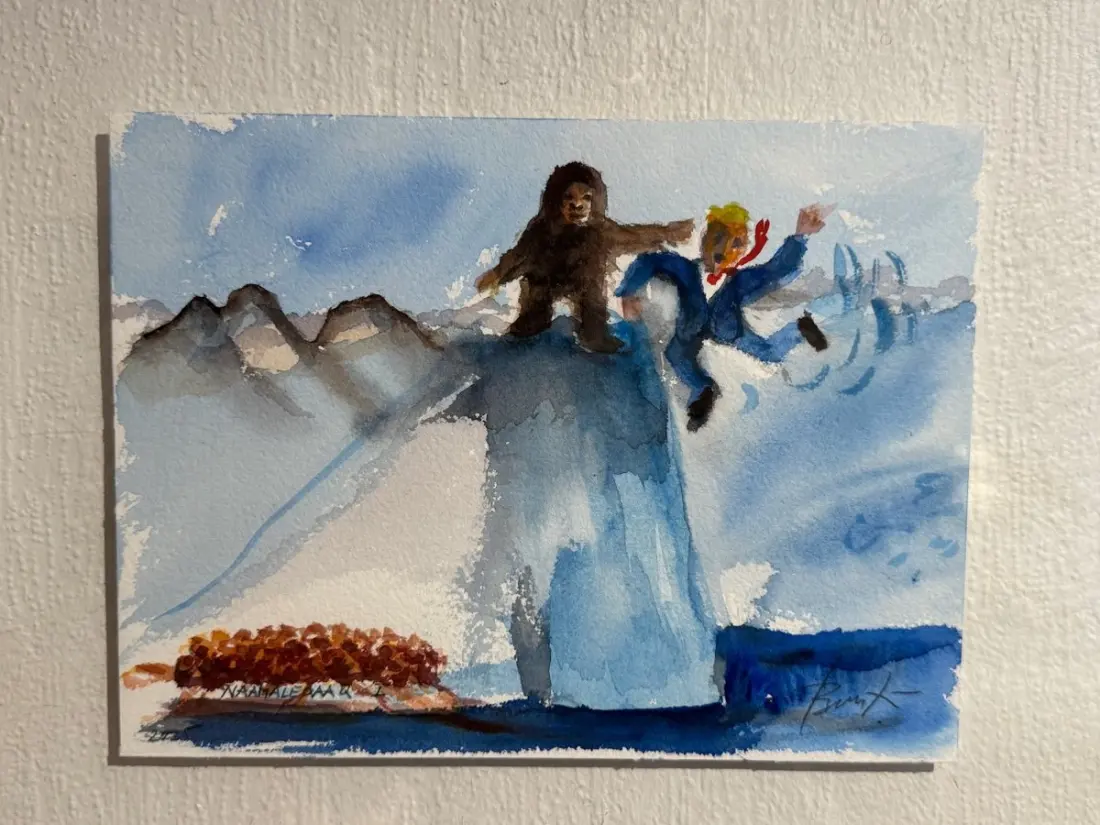
Greenland's capital has no shortage of ice, but one of its most rewarding stops is indoors. The Nuuk Art Museum, housed in a former Seventh-day Adventist church with about 600 square metres of gallery space, packs a surprisingly layered story into a modest footprint — and it's an ideal stop after the Greenland National Museum and Archives, which sits within walking distance.
The museum's origins are personal. It grew out of the private collection of businessman Svend Junge and his wife, Helene Junge Pedersen, who gave it to the people of Nuuk. It opened in 2005 and was formally inaugurated on Greenland's National Day in 2007. Today the permanent collection spans paintings, watercolours, prints, photographs and sculpture carved from soapstone, bone, ivory and wood.
What makes it worth an hour or two of any Nuuk itinerary is the contrast at its heart. On one side sit the works of visiting Europeans, most prominently Danish painter Emanuel A. Petersen, whose romantic canvases show mountains, icebergs and tiny settlements in glowing, almost dreamlike tones. Contemporaries like Christine Deichmann, J.E.C. Rasmussen and Harald Moltke likewise documented the Arctic as outsiders, rendering Greenland as a majestic, distant fantasy.
Alongside them hang works by Greenlandic artists — Hans Lynge, Anne-Birthe Hove, Buuti Pedersen, Miki Jacobsen, Simon Kristoffersen and Pia Arke among them — who see their country very differently. Their art engages with identity, colonialism, mythology and urbanisation, and the realities of living in a demanding environment. One visitor even noted work riffing on the current American president. The result is not a single official image of Greenland but a conversation: Greenland imagined by Europeans, Greenland remembered through tradition, and Greenland described by the people who live there.
For travellers, that framing is genuinely useful. Most visitors arrive with postcard expectations shaped by exactly the kind of romantic landscape painting Petersen produced. Seeing those images hung next to contemporary, sometimes confrontational Greenlandic perspectives gives you context that no glacier selfie can. It's a compact, inexpensive way to understand what you're about to see outside — and Nuuk itself, a small, walkable capital with a growing food and culture scene, is easy to explore on foot between museums.