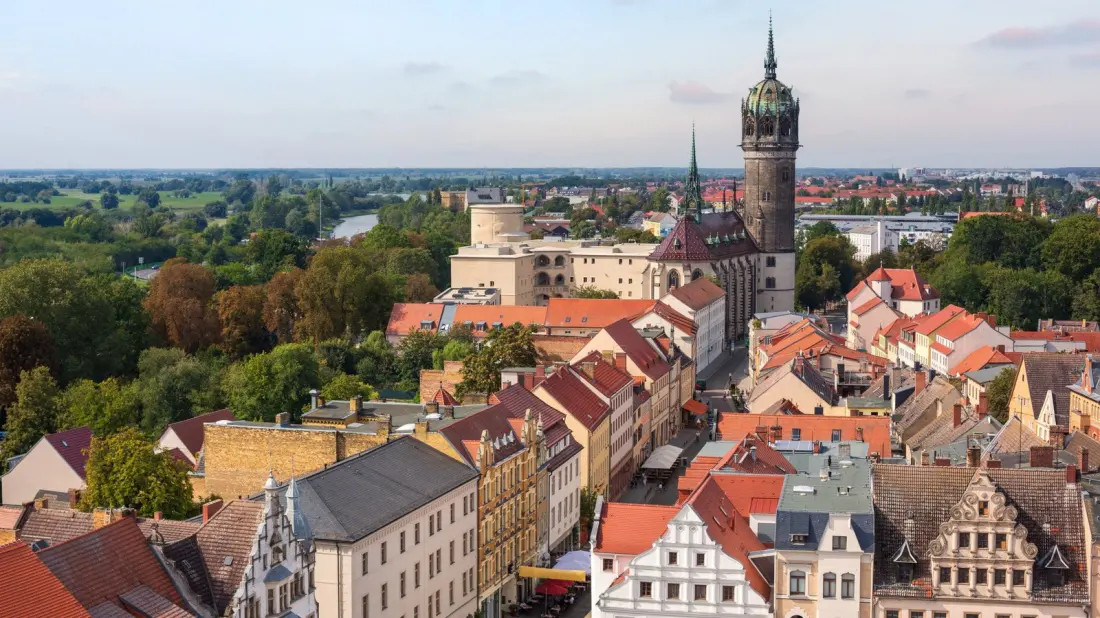
An hour south of Berlin, the little riverside town of Wittenberg packs more history per cobblestone than almost anywhere else in Germany. Officially named Lutherstadt Wittenberg, it's where a monk and professor named Martin Luther published his 95 Theses in 1517 — traditionally by pinning them to the door of the Castle Church — and lit the fuse of the Protestant Reformation. The town got town rights back in 1293, but 1517 is the year that put it on the map, and it's been drawing pilgrims, history nerds and casual weekenders ever since.
Start at the Schlosskirche, the Castle Church built between 1489 and 1509 under Elector Frederick the Wise. The original wooden doors burned in the 1700s; in their place stand grand bronze doors cast in 1858, engraved with all 95 Theses. Inside there's a neo-Gothic interior, stained glass, and Luther's own tomb. Climb the roughly 300-foot tower — it's a stair workout, but you get a full 360-degree view over the town's rooftops, and Tripadvisor ranks the church as the No. 1 thing to do in Wittenberg.
A short walk away, St. Mary's Church (Stadtkirche) is known as the "Mother Church of the Reformation." Luther preached here from 1512 and married Katharina von Bora here in 1525. Don't miss the 1547 Cranach workshop altarpiece, which cheekily paints Luther among the disciples at the Last Supper.
Four of the six UNESCO-listed Luther Memorials sit in Wittenberg. The big one, the Luther House — a former Augustinian monastery where Luther lived first as a monk and later with his wife and six children — is closed for renovations until spring 2027, but key artifacts are displayed in the adjacent Augusteum. Meanwhile the Melanchthon House, a 1536 Renaissance townhouse with a fanciful gable, is open and shows how Luther's friend and fellow reformer actually lived.
Leave some time to simply wander. The lanes around the Market Square glow in sunshine yellows and rosy pinks, and the Hundertwasser School, remodeled in the late 1990s to the artist's riotously colorful designs, is a fun oddity. If you come between late November and late December, the Christmas market fills the Market Square with decorated stalls.
Why it matters: Wittenberg is one of Germany's easiest day trips — around 40 minutes by train from Berlin, 30 from Leipzig, with Berlin Brandenburg (BER) as the nearest major airport. May to September brings the best weather, with highs around 67 to 76°F. History buffs could easily fill a day here; anyone with a spare afternoon in the capital can squeeze in the castle church and a stroll. And if Luther hooks you, add Eisenach to the itinerary, where Wartburg Castle is the spot where he translated the New Testament in 1521-22.
Story via Islands.