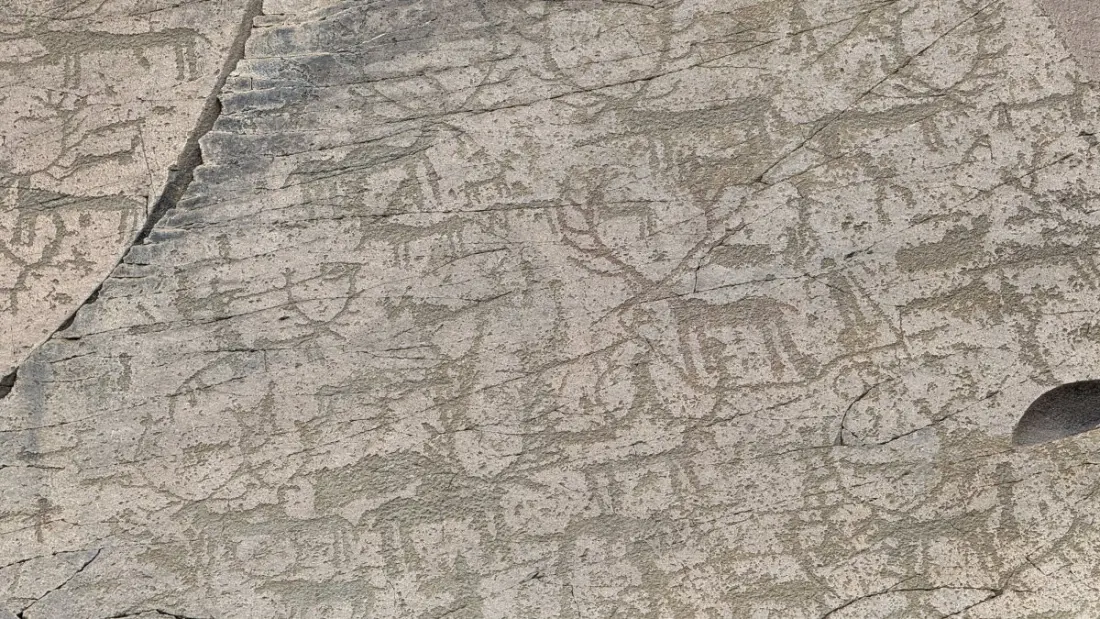
High on rocky surfaces near Camuşlu village in eastern Türkiye, more than 100 carved figures of mountain goats and deer have survived for thousands of years — and they're drawing fresh attention to one of Anatolia's most overlooked corners.
The paintings, in the Kağızman district of Kars province, sit along one of the historic corridors connecting the Caucasus to Anatolia. That position made Kars a crossroads of migrating peoples for millennia, and the rock art is a record left by those who passed through or settled there.
According to Mustafa Karageçi, an associate professor of ancient history at Kafkas University, decades of fieldwork have identified numerous rock art sites across the region. Systematic studies were led by professor Alpaslan Ceylan from 1999 to 2012, then continued under professor Akın Bingöl from 2012 to 2022. The Camuşlu site alone holds over 100 figures, dominated by mountain goats, deer and similar animals.
Karageçi explains that the images were made by nomadic groups etching their relationship with nature, along with their fears and beliefs, directly onto the rock. Before writing existed, he notes, this was how people declared "we were here, and we lived here." The paintings are linked to the Paleolithic Age and later eras, and the craftsmanship is striking: makers used flint stones to engrave smooth rock faces, patiently carving each image by hand.
For travellers, this adds another layer to a province already rich in history. Kars is best known for the haunting ruins of Ani, a medieval Silk Road city on the Armenian border, plus its distinctive Russian-imperial architecture and a food scene famous for honey, gravyer cheese and piti stew. The Kağızman rock art extends that timeline back to the very dawn of human settlement in Anatolia — a chance to see some of the region's oldest surviving imagery in a remote, dramatic setting.
Who's it for? Anyone drawn to archaeology without the crowds, road-trippers exploring eastern Türkiye beyond Cappadocia and Istanbul, and history-minded travellers heading toward the Georgian or Armenian border crossings. The sites are in rural village territory, so a car and a local guide make sense — but that remoteness is part of the appeal. You may well have the rocks, and their carved goats, entirely to yourself.