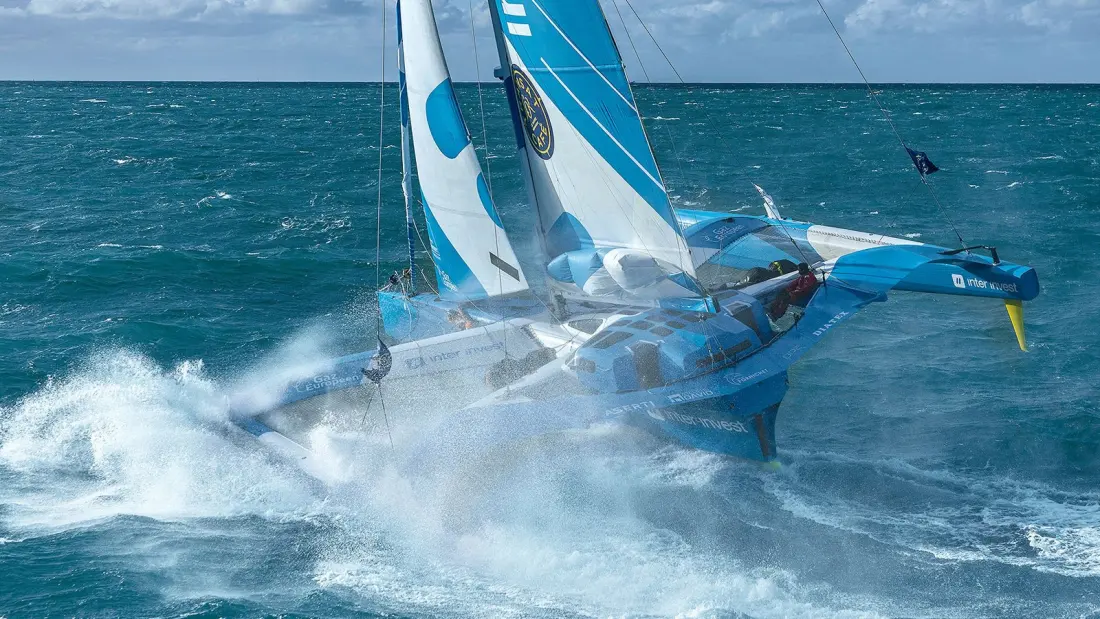
Delivery passages — the unglamorous business of moving a racing boat from A to B between events — have quietly become one of the best training grounds in offshore sailing. That's the argument of Michaela Robinson, an offshore racer who landed an internship with 11th Hour Racing during the 2023 Ocean Race and was then picked from 120 applicants for the all-female UpWind by MerConcept Ocean 50 campaign. Delivery crewing is a core part of the job, and she treats every passage as a chance to get better.
The big adjustment is mental. A delivery is not a race, and the priority flips from speed to preservation: get the boat and crew there safely, with minimal wear and tear. On high-performance trimarans that's no small caveat — four Ocean 50s have capsized in the past year. Robinson avoids the aggressive reaching angles between 90° and 110°, known in multihull circles as the 'Death Zone', and steers for safe, stable angles in stronger conditions.
Anticipation beats reaction when you're short-handed. Her advice: use the routing software to see squalls coming, and reef or drop a headsail an hour before the wind arrives, even if it costs a few knots. Being under-canvassed on a delivery is seamanship, not weakness. Before any headsail change she bears away deep to soften the apparent wind and steady the boat; for a main reef, she keeps the jib drawing and heads up just enough to let the mainsail flap while the lines are secured.
The quiet hours also lend themselves to drills. Robinson practises programming the autopilot to bear away and gybe — adding a manual extra 10° to the preset gybe angle for a bolder, cleaner turn. She runs MOB routines too: a sharp, unmistakable course change at the helm carves a clear reference mark on the plotter, which she finds more reliable than fumbling for a digital MOB button while watching a person in the water. And in conditions where a fast gybe is too risky, a 'granny tack' — tacking around instead — is a perfectly respectable low-risk manoeuvre.
Just as important is the human side. Delivery crews often mix experience levels, so Robinson pushes for a low-ego culture: no stupid questions, everyone speaks up when overwhelmed, and juniors on watch in rough weather always have a senior sailor awake and ready to step in. Overconfidence, she says, is the biggest danger on board.
Finally, treat the trip as a test lab. Older sail inventories protect the race kit, but with the same layout you can experiment freely — ease the jib, tweak the inhauler, move the traveller — and watch what each adjustment does to speed and balance. Short-handed deliveries also push everyone out of their specialism, whether that's learning the bow or getting fluent with navigation software.
For any sailor eyeing offshore sailing — or simply delivering a charter boat this season — the takeaway is that slow miles are still valuable miles. Racing purists might see deliveries as dead time; Robinson makes the case that they're where the real learning happens, away from the tunnel vision of a race start.