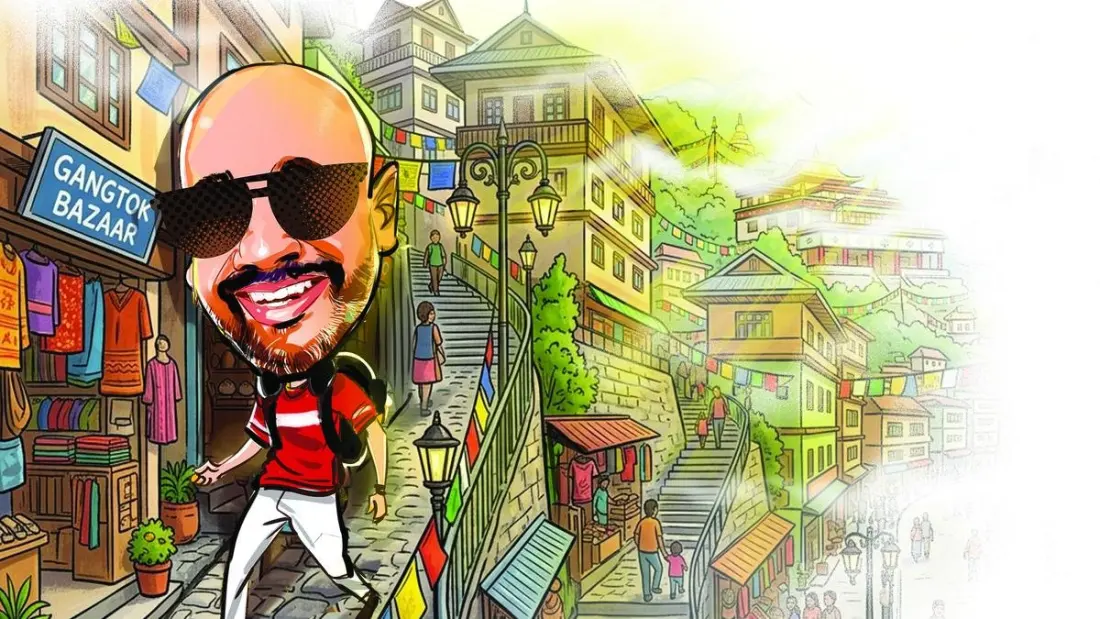
Most Indian cities are an obstacle course for anyone on foot — missing pavements, aggressive traffic, nowhere to cross. Sikkim's capital, Gangtok, flips that script. Novelist Prajwal Parajuly, who grew up there, argues it may be India's most walkable city, and the details back him up.
Walking is simply how life works in this hilltop town of around 150,000 people. School runs, tuition classes, errands, social calls — all done on foot, often 4-5km a day, up and down slopes that would humble most visitors. The stairs, footpaths and flyovers knit together so well that you can genuinely run your entire life without a car. Parajuly walks to his dentist, his tailor, his favourite bookshop (Rachna Books), and says it's faster than driving.
The centrepiece is MG Marg, the main square, which went car-free in 2009. Shopkeepers initially panicked that losing vehicles would kill business, and residents worried about practicalities like getting elderly relatives to hospital. Instead, the cobbled, vehicle-free stretch became the city's pride — a place where people actually linger, meet and shop rather than drive through. Its cleanliness and order have made it a benchmark that other hill stations, in Parajuly's words, struggle to match, and it's a big reason middle-class Indian travellers photograph the town so lovingly.
Beyond the square, a 12km footpath runs alongside the highway, snaking through the suburbs of Tadong, 5th Mile and 6th Mile, and you can follow it all the way to the neighbouring town of Ranipool without ever losing the pavement. These are proper footpaths, with railings on both sides — a rarity anywhere in South Asia. Ambitious walkers could even follow the highway towards Kalimpong in West Bengal, 76km away; Parajuly and a cousin once managed about 60km in a day before darkness stopped them.
There are caveats. Gangtok still has traffic jams — you need proof of parking space at home to buy a car, and an odd-even scheme helps, but locals increasingly drive distances they'd once have walked. Parajuly also credits only Chandigarh as a rival for pedestrian-friendliness, with Shimla, Pondicherry, Pune and Shillong trailing behind.
For travellers, this is the real appeal: Gangtok is one of the few Indian cities where exploring on foot is a pleasure rather than a hazard. Base yourself near MG Marg, stroll the car-free square in the evening, and use the footpaths to reach monasteries, hilltop temples and viewpoints that day-trippers see only from a taxi window.