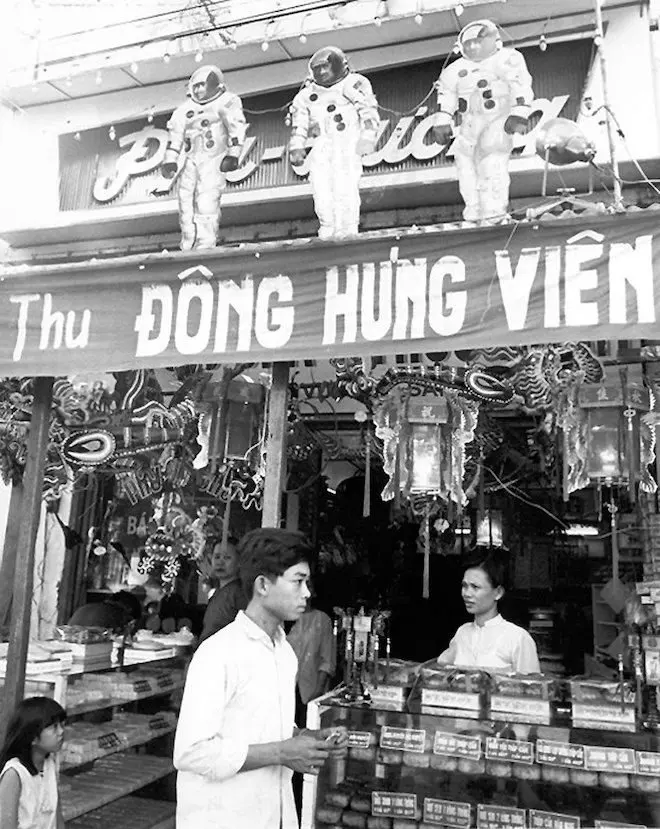
Archival photographs from the early 1900s are giving travellers a vivid window into how Hanoi celebrated the Mid-Autumn Festival long before plastic, battery-lit toys existed — and the images, shot in early autochrome colour, feel remarkably close to what you can still see in the Old Quarter today.
The pictures come largely from French photographer Léon Busy, who worked for the Albert Kahn Collection, and they date from 1915 through the 1930s. One striking 1915 shot shows a toy shop on Hang Gai Street stacked with accordion lanterns, rabbit shapes, paper flowers and miniature lion dance heads. Others from 1926 and 1928 capture children parading through the streets with oversized star lanterns, or smiling beside wheeled rabbit lanterns during the eighth lunar month.
What the photos document is a craft tradition. The centrepiece was the five-pointed star lantern, built by hand from split and curved bamboo strips stretched with dyed red and green cellophane. Artisans also shaped carp and rabbit lanterns on bamboo frames, and the most ingenious creation was the đèn kéo quân — a revolving shadow lantern powered purely by the heat of a single candle, which turned an internal paper wheel and projected silhouettes of folk heroes, dancers and animals onto translucent panels.
The festive action centred on Hang Gai and Hang Mã, two historic guild streets in central Hanoi that served as the city's great open-air markets for toys and papercrafts. Families walked there with their children as soon as the eighth lunar month began. Beyond the main stalls, neighbourhood dry-goods vendors set up curbside displays selling lion heads, papier-mâché masks of Chu Teu — the round-faced, jovial folk character — and firecrackers. Tinplate mechanical toys were the coveted big-ticket gift of the era.
Historians still debate whether Mid-Autumn grew out of Vietnam's ancient wet-rice farming culture or arrived through exchanges with neighbouring traditions, but it is at least two thousand years old and was already the most anticipated event of the year for children by the 1920s. Lion dancing, lanterns and harvest cakes were all central then, exactly as they are now.
Why it matters for travellers: if you visit Hanoi in autumn, you can walk the same streets and see the tradition alive. Hang Mã in particular still erupts in lantern displays in the weeks before the festival, and the handmade star lantern survives alongside its battery-powered rivals. The vintage images are a reminder that the festival's real draw has never been technology — it's the atmosphere: candlelight in paper, lion drums, mooncakes, and families out late under the full moon. Timing a trip for the Mid-Autumn Festival (the 15th day of the eighth lunar month, usually September or early October) puts you right inside a celebration that these century-old photos prove hasn't lost its soul.