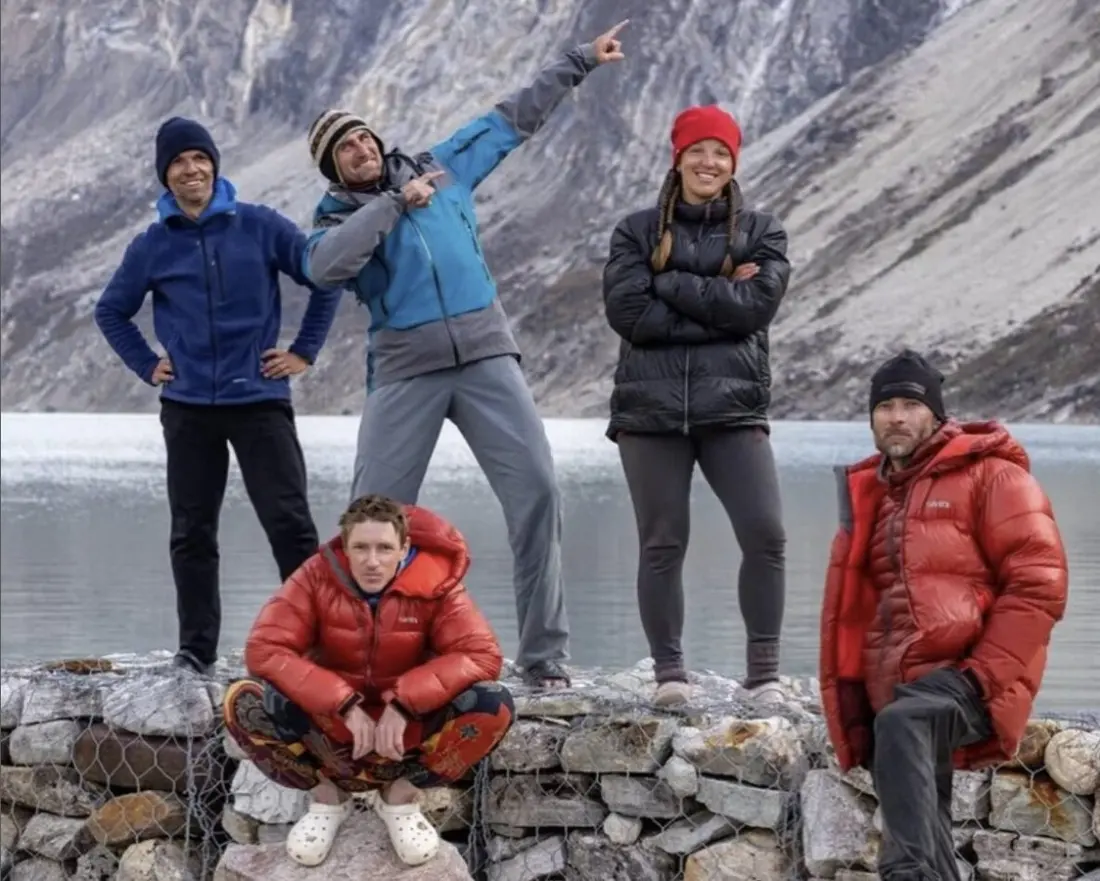
Fresh off a prized new line on the Southwest Face of Manaslu, Andrey Vasiliev's all-Russian climbing team wants to take on a bigger prize: an alpine-style new route on Everest. There's one problem — as departure day approached, they were still short about $24,000 for the reconnaissance and acclimatisation climb this autumn, with the full spring expedition expected to cost nearly $240,000.
Vasiliev's crew — Sergey Kondrashkin, Vitaly Shipilov and Natalya Belyankina — earned the Russian equivalent of the Piolet d'Or for their 2025 Manaslu route, and ExplorersWeb counted it among the year's best expeditions. Vasiliev also has history with Everest, having led two notable attempts on its South Face. The plan is ambitious by any standard: no fixed support, no supplemental oxygen, and no other climbers around, since a new route in autumn would put them alone on the mountain.
The extra 700 vertical metres between Manaslu's 8,163m summit and Everest's 8,849m is a serious step up without bottled oxygen, which is why Vasiliev wanted an autumn trip first — to test gear and see how their bodies cope at extreme altitude before committing to the full climb next spring. They were due in Kathmandu to scout, but logistics on Everest are never simple: a solo team would still have to get through the Khumbu Icefall, possible with good snow cover — Polish ski mountaineer Andrzej Bargiel managed it last autumn — or via a route that avoids it altogether.
With money tight, the team has drawn up alternatives. Plan A is Everest; Plan B and C involve more affordable 8,000m peaks or a lesser summit. Nepal's autumn permit fees explain the maths: Everest costs $7,500 per climber in the fall on the standard South Col route, or $5,000 for a different line — far below the $15,000 spring fee. Manaslu runs $3,000 per person in autumn, while Lhotse, Kangchenjunga, Makalu, Dhaulagiri and Annapurna each cost just $1,500.
For travellers, the story is a window into the realities of modern high-altitude mountaineering: even a stripped-back, unsupported alpine push on the world's highest mountain costs roughly a quarter of a million dollars, and even elite teams with proven track records scramble for sponsorship. If the funding lands, watch for a rare sight — a small team carving an unclimbed line on Everest in the quiet autumn season, with no crowds, no oxygen and no safety net. If it doesn't, one of Nepal's other giants will likely get a new route instead.