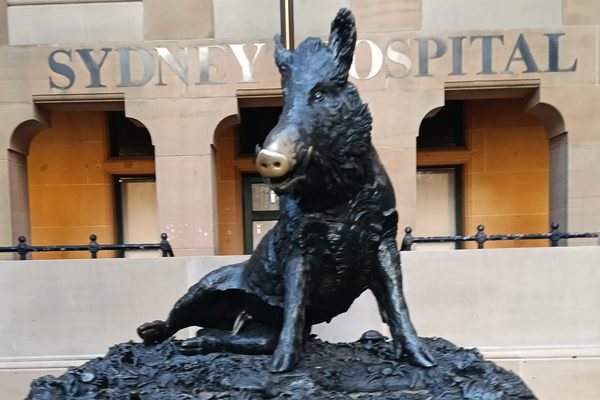
On Macquarie Street, right outside Sydney Hospital, a bronze wild boar squats over a fountain basin with a snout polished to a bright golden shine. It looks familiar for good reason: it's a 1:1 scale replica of Il Porcellino, Pietro Tacca's 17th-century boar in Florence's Mercato Nuovo. Rub the snout, drop a coin, get your luck — the same ritual that draws queues in Tuscany plays out daily in the middle of Sydney's CBD.
The Sydney version, though, has a job its Florentine twin doesn't. Every coin dropped through the grate below is collected and passed to the Sydney Hospital Foundation, which puts the money toward medical equipment and research. Staff have nicknamed the statue "The Silent Volunteer" — a fitting title for something that's been collecting micro-donations nonstop for more than fifty years.
The backstory is a family one. The boar was donated in 1968 by Italian Marchesa Clarissa Fiaschi Torrigiani, cast specially by Florence's Ferdinando Marinelli Artistic Foundry. She wanted to honour her father, Dr Thomas Fiaschi, and her brother, Dr Piero Fiaschi, both surgeons at Sydney Hospital and military medical heroes for Australian forces abroad. Thomas had emigrated from Florence in the late 19th century, bringing pioneering surgical techniques to Australia along with a love of Italian culture — he even founded Sydney's chapter of the Dante Alighieri Society and made wine. The bronze boar was, in effect, a Florentine thank-you note set down at the door of Australia's oldest hospital.
It's a two-minute stop that rewards a slow walk through the historic core of the city. Sydney Hospital sits on Macquarie Street, a short stroll from Martin Place and the Royal Botanic Garden, so the boar slots easily into any day spent wandering between Circular Quay, the Domain and Hyde Park. Rub the snout (everyone does — that's why it gleams), toss in a coin, and you've contributed to a working hospital without breaking stride.
For travellers, this is the kind of detail that makes a city interesting beyond its postcards: a piece of Renaissance Florence transplanted to the southern hemisphere, still doing useful work. It's free, it takes seconds, and it comes with a story you can tell over dinner — plus, if you believe the Florentine original's promise, it might just guarantee you a return trip.