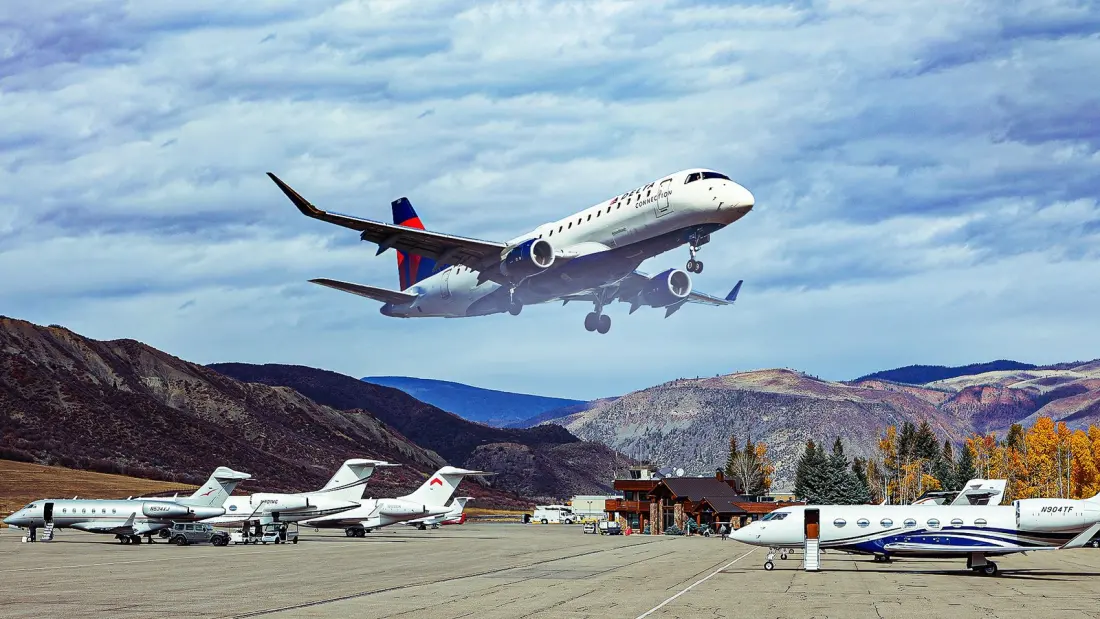
Aspen/Pitkin County Airport is one of the trickiest places to land a jet in America. Sitting 7,820 feet above sea level with a runway barely longer than 8,000 feet and mountain peaks on all sides, it has long punished heavier regional aircraft, especially on hot afternoons when thin air saps engine thrust. That is why the Embraer E175 — a bigger, more comfortable regional jet — sat out Aspen flights for years, while airlines kept flying the smaller, aging Bombardier CRJ700.
The fix turned out to be code, not metal. Embraer, General Electric and SkyWest Airlines reworked the engine's FADEC software — the digital brain that controls the GE CF34-8E turbofans — so it delivers 1% to 3% more thrust at full takeoff power. Paired with recalibrated takeoff and landing speed schedules, that modest boost is enough for the E175 to meet the FAA's demanding single-engine climb gradients out of Aspen with a full cabin. Crucially, cruise fuel burn stays untouched, so the jets can rotate between mountain routes and everyday regional flying without penalty.
The aircraft also squeaks under another hard limit: Aspen caps wingspans at 95 feet across its taxiways and ramps, and the E175's 93-foot-11-inch span clears it by about two feet. Its Honeywell avionics fly the RNAV M Rwy 15 approach — a curved path threading the valley that allows landings in weather that would force older jets to divert to Grand Junction or Denver.
The practical result for travellers: in November 2025, Delta Connection (flown by SkyWest) retired the CRJ700 on nonstops from Atlanta and Los Angeles and switched to the upgraded E175. That means six more seats per flight under limiting conditions, and double the first class cabin — 12 seats instead of six — a real advantage on a route filled with well-heeled ski travellers. United proved the concept back in December 2024 with the same SkyWest-operated jets. SkyWest plans a dedicated subfleet of 25 Aspen-capable E175s by the end of 2026, serving both Delta and United.
The odd one out is American. Still flying CRJ700s into Aspen from Dallas/Fort Worth and Phoenix, it fields only nine premium seats and can be forced to leave up to 10 seats empty on hot afternoon departures to meet climb requirements — plus it lacks the precision-approach avionics that cut weather diversions. Expect pressure on American to follow suit as the software-modified E175 becomes the new baseline for high-altitude resort routes across the American West.
For skiers and second-home travellers, the takeaway is simple: more nonstops, more premium seats, and fewer storm-day diversions into Aspen.