Watching a king eat his supper sounds like the strangest ticket in town, but for courtiers at Versailles it was a nightly privilege. Le Grand Couvert — the public royal meal of the Bourbon era — turned dinner into pure spectacle: the royal family dined alone at a lavishly set table while a packed room of onlookers observed in total silence.
Louis XIV was the ritual's biggest fan, dining in public every single night. His appetite was the stuff of legend — his sister-in-law, Princess Palatine, claimed to have watched him put away four plates of soup, a whole pheasant, a partridge, a large salad, ham, garlic mutton, pastries, fruit and hard-boiled eggs in one sitting. His successors were less keen: Louis XV hated the formality and preferred private dinners with his mistresses, and by Louis XVI's reign the Sunday 10pm Grand Couvert was already an antique. Marie Antoinette reportedly despised it, picking at her food and yawning to speed things along.
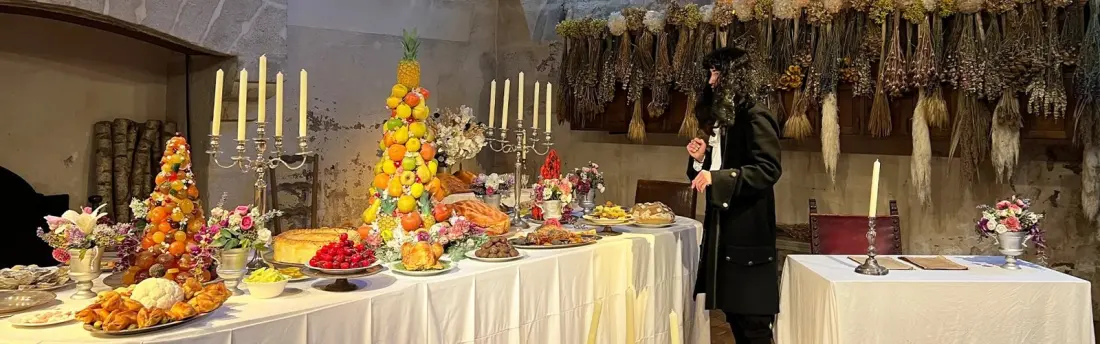
The logistics were staggering. Feeding the king and up to 10,000 courtiers a day took a kitchen brigade of 500, under the 'Bouche du Roi' — a branch of the 2,000-strong royal household divided into seven sections, fruit and bakers included. Meals arrived in choreographed waves, service à la française style, with up to eight dishes on the table at once: soups, roasts, salads, pastries and towering stacks of hard-boiled eggs for bedtime snacking. Because the food travelled far from the kitchens, it usually arrived cold — goldsmiths devised warming tableware, but with little success.
Paranoia about poisoning shaped the whole ritual. Armed guards escorted each dish, at least two tasters sampled everything before the king ate, and drinking was its own ceremony: the Cupbearer would call for 'a drink for the King!', pour wine and water at a sideboard, wait for it to be tasted, and present the glass a full seven minutes later — which the king had to drain in one before it was covered again. Legend even credits this tasting obsession with why vichyssoise is served cold.
Provisions came from Louis XIV's prized 23-acre kitchen garden beside the palace, run by head gardener Jean-Baptiste de La Quintinie, who pulled off out-of-season wonders like December asparagus, March strawberries and even bananas. Nothing went to waste: leftovers passed down the court hierarchy by rank, and whatever survived was sold to merchants hawking it outside the palace gates with heavily spiced sauces — handy in an era when French cuisine was, frankly, bland.
The Grand Couvert eventually died out along with the Ancien Régime, but for travellers it adds real colour to a Versailles visit. Stand in the antechamber where the royal table stood, stroll the restored kitchen garden (now the King's Kitchen Garden, open to visitors), and picture the whole gilded, paranoid, over-fed machine at work. It's a reminder that at Versailles, even dinner was politics.