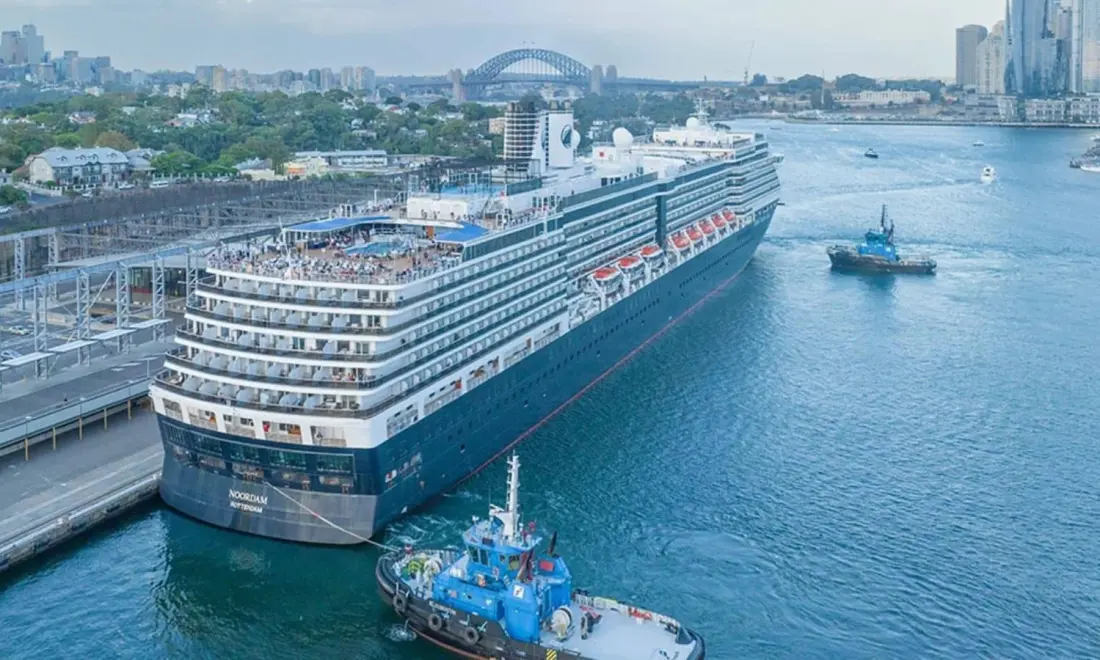
Cruise ships docking at White Bay in Sydney will soon be able to switch off their engines entirely. Australia's first shore-powered cruise terminal is being fitted with its onshore power supply this week, with the whole project expected to wrap up by the end of the year — meaning visiting ships could plug in as early as this cruise season.
Shore power lets a berthed ship draw electricity from the land grid instead of idling its engines, cutting emissions, noise and fuel burn while in port. At White Bay, that's estimated to remove more than 4000 tonnes of carbon a year — the equivalent of taking roughly 1100 cars off New South Wales roads.
Australia has been slow on this front. Ports across North America and Europe have offered shore power for years, while no other Australian port has a publicly announced project in the works. White Bay is the test case that could prompt others to follow.
The engineering behind it is the interesting part. Ten shipping containers on the wharf house a dense network of transformers, converters and switchgear that feed high-voltage power to docked ships, linked by underground cabling. To keep all that equipment cool without noisy, energy-hungry air conditioning, the Port Authority of NSW borrowed an idea from the Sydney Opera House: a seawater cooling system that draws water straight from the harbour and circulates it through heat exchangers. It's the first time such a system has been installed in an operating Sydney port.
For cruise passengers, the payoff is subtle but real. Ships at shore-powered berths are dramatically quieter overnight, which makes waterside neighbourhoods like Balmain more liveable and makes overnight port stays more viable for cruise itineraries. Lines also save on fuel while plugged in — costs that ultimately shape what cruise holidays cost. And if you care about the environmental footprint of your holiday, cleaner ports are one of the more tangible upgrades the cruise industry can make, since ships traditionally burn fuel around the clock even when going nowhere.
Port Authority of NSW chief executive John McKenna has framed the project as proof that sustainable port infrastructure can deliver long-term environmental benefits, and project director Fauzan Zulkhepli has called it one of the most technically complex harbour-side builds underway in the state.
Whether you're cruising in or out of Sydney this season or just live near the harbour, White Bay is worth watching: it's the first hint of what a lower-emissions cruise industry could look like in Australia.