
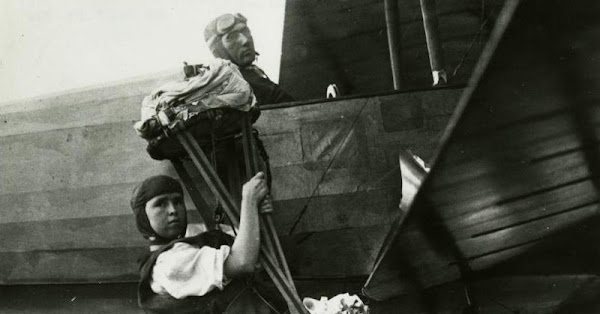
On June 21, 1913, a woman weighing barely 80 pounds sat on a small swing-like seat outside an airplane over Los Angeles, pulled a release lever, and fell. Georgia Ann "Tiny" Broadwick landed safely in Griffith Park, becoming the first woman ever to parachute from an airplane. She stood barely over four feet tall — a trait that had made her a fairground curiosity — but it was her nerve that made history.
Broadwick was born Georgia Ann Thompson in 1893 near Oxford, North Carolina, so small at birth (three pounds) that the nickname stuck for life. Her early years were brutal: cotton mill work, marriage at twelve, motherhood at thirteen, and an abandoned household soon after. At fifteen she saw parachutist Charles Broadwick jumping from a hot-air balloon at a fair and talked her way into his travelling show. Her first jump, at the North Carolina State Fair in 1908, ended in a blackberry bush — and she was hooked, later describing the view from above as the most wonderful sensation in the world.
In 1912 aviation pioneer Glenn L. Martin offered her a chance to jump from one of his planes, and Charles Broadwick built her a backpack-style parachute for the attempt. The June 1913 leap over Griffith Park was followed that same year by two more firsts: the first parachute descent from a seaplane and the first woman to jump into water, landing in Lake Michigan.
Her most consequential moment came in 1914, when the U.S. Army invited her to demonstrate parachutes for skeptical military pilots at North Island in San Diego. On her fourth jump, the static line snagged on the aircraft's tail. Trapped and unable to climb back in, she cut herself free, then manually pulled the remaining cord to open her chute. In effect, she had just demonstrated the ripcord method — the principle behind manual parachute deployment that became a cornerstone of pilot safety and standard parachute design.
Broadwick racked up more than 1,100 jumps in an era when aviation itself was barely off the ground, surviving broken bones and countless close calls. Ankle injuries pushed her into retirement in 1922, in her late twenties. Honours and hall-of-fame inductions followed, and her parachutes are now preserved in collections including the Smithsonian Institution.
Why does this matter to travellers? Because so many of the places tied to her story are worth a detour: Griffith Park remains one of Los Angeles' largest urban parks, North Island sits beside Coronado in San Diego Bay, and North Carolina's state fair still runs every October in Raleigh. Skydiving is now a mainstream adventure activity offered at drop zones worldwide — a freedom that traces directly back to a determined teenager from a North Carolina mill town. For aviation buffs, the Smithsonian's National Air and Space Museum in Washington, D.C. is the natural pilgrimage point to see artefacts from this era up close.
Her story is a reminder that some of aviation's biggest leaps were made by the smallest people, and that the destinations where it happened are still very much on the map.