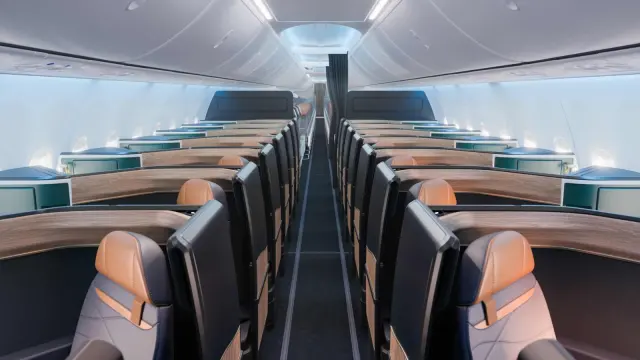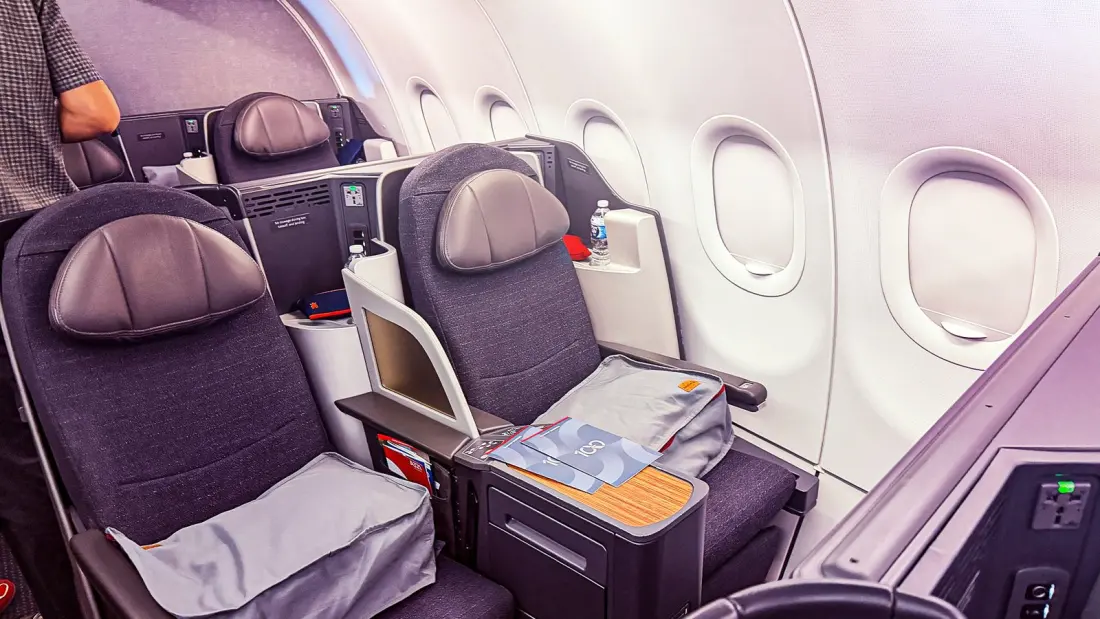
American Airlines is giving up on one of the quirkiest aircraft in the US skies. Its 17 Airbus A321Ts, squeezed down to just 102 seats so New York–Los Angeles and New York–San Francisco flyers could get lie-flat beds and a small first-class cabin on a single-aisle jet, will be stripped out and refitted to carry roughly 190 to 196 passengers — an increase of 88 to 94 seats per airframe. The premium transcon mission ends on 28 March 2027.
For context on how unusual the A321T was: a normal A321 carries well over 190 people, and the little jet's old layout packed in 10 Flagship First seats, 20 Flagship Business seats and 72 economy seats. That kind of space only pays off if the New York–California premium market consistently fills it, and American has decided it would rather spread premium seats across hundreds of narrowbodies instead of hoarding them on two routes.
The transcon premium job now falls to the Airbus A321XLR, which American was the first US airline to fly. Its layout has 20 new Flagship Suites — each with a privacy door and chaise-lounge seating — plus 12 Premium Economy and 123 economy seats, for 155 total. Crucially, the XLR isn't locked to domestic flying: American has already used it on New York–Edinburgh, so the same jet can rotate between premium transcon and longer international missions.
Elsewhere in the fleet, A319s are being refitted with 12 premium seats and A320s with 16, alongside bigger bins and power at every seat. American expects premium seating overall to grow more than 20% by 2026, and lie-flat capacity on international jets to rise over 50% by decade's end, thanks to 787-9s, A321XLRs and refurbished 777s. The demand case is real: premium corporate bookings rose nearly 15% in the year to May 2026.
What does this mean if you're flying? If you loved the lie-flat A321T on JFK–LAX or JFK–SFO, that era is nearly over — book the XLR routes instead, where the Flagship Suite is arguably a better product anyway. If you're in economy on a domestic American flight, things should actually improve: the former A321Ts return as ordinary high-capacity narrowbodies, and from 2028 American is putting seatback screens at every seat (reversing its old screen-free stance), while Starlink Wi-Fi spreads to more than 500 narrowbodies from 2027.
It's a clear shift in philosophy: rather than building a handful of aircraft around one market, American is building a fleet that can shuffle capacity and premium inventory wherever demand is strongest. Premium isn't going away — it's just everywhere instead of in one place.