
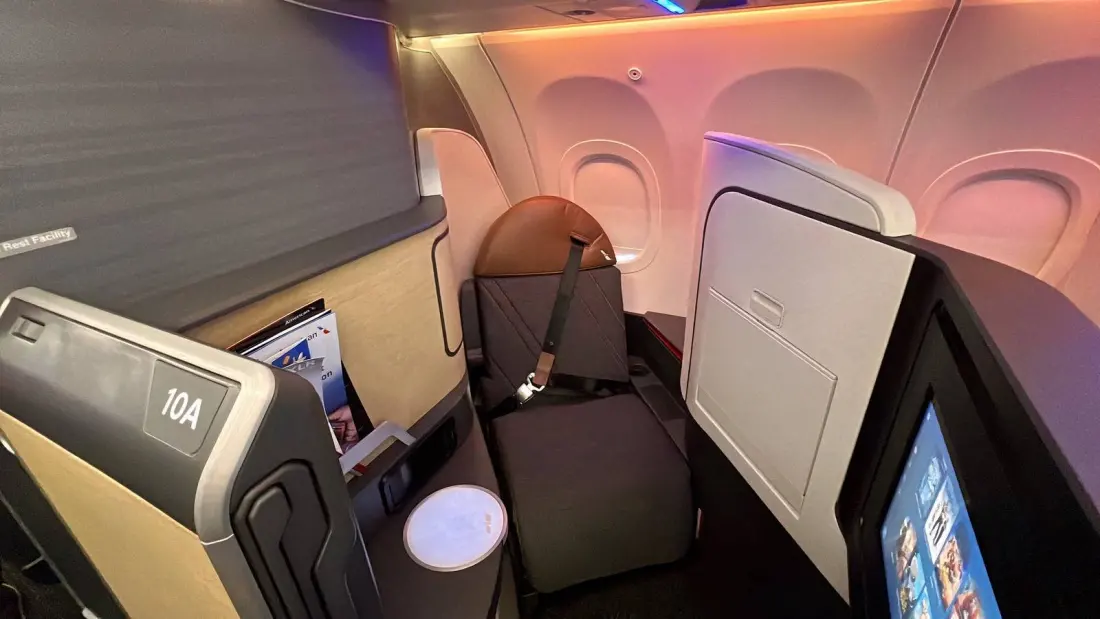
American Airlines' shiny new Airbus A321XLRs have a problem: some of their flagship business class suites keep jamming, and the airline is now flying several jets with those suites blocked from sale entirely.
The fault lies with the seat control systems on the Flagship Business suites, which are built on the Collins Aerospace Aurora platform. When the controls fail, the lie-flat seat gets stuck either upright or reclined. Rather than sell a seat that can't lie flat on a long-haul flight, American marks it inoperative and leaves it empty. Recent seat selection data showed at least one suite out of action on several A321XLRs, and more than one on some aircraft. Unlike the usual culprit — passengers dropping phones or keys into seat mechanisms — this appears to be the control hardware itself misbehaving.
That stings for American because the A321XLR is its premium long-haul play. Each jet carries just 155 passengers: 20 business suites, 12 premium economy seats and 123 in the main cabin. The type is being flown on high-yield transcontinental and transatlantic routes, exactly the markets where lie-flat business seats command top dollar. It has been a bumpy rollout all round — the first delivery slipped from July to October 2025 thanks to seat supply chain problems, the privacy doors on the suites flew locked open for months awaiting FAA certification, and only got switched on across the fleet this autumn.
American knows it has a cabin quality issue. It recently launched a programme called OneCabin, adding 60 maintenance technicians purely to fix cabin defects. Chief customer officer Heather Garboden was blunt about the reason: too many broken seats, too many dead in-flight entertainment systems, and "duct tape where we should not have duct tape."
There's more growth coming regardless. American has 50 A321XLRs on order (eight delivered so far), and four new European routes kick off in 2027: New York JFK to Amsterdam and Philadelphia to Porto in late March, then JFK to Nice and Philadelphia to Vienna in May. The jet debuted across the Atlantic this summer on a seasonal New York–Edinburgh service, with a range of roughly 4,700 nautical miles. Not everyone on board is thrilled, though — flight attendants have complained the layout is hard to work, citing a strange lavatory arrangement (one at the front, three at the back), cramped galleys and weak crew rest facilities.
For travellers, the practical takeaway is simple: if you're booking Flagship Business on an A321XLR, it's worth checking the seat map before you fly. With a real chance a suite or two is out of service, downgrade-or-refund scenarios are more likely than usual — and if a working lie-flat seat matters to your trip, you may want a fallback aircraft or airline in mind. If the seat map shows 19 or fewer business seats available, you're probably looking at one of the affected jets.