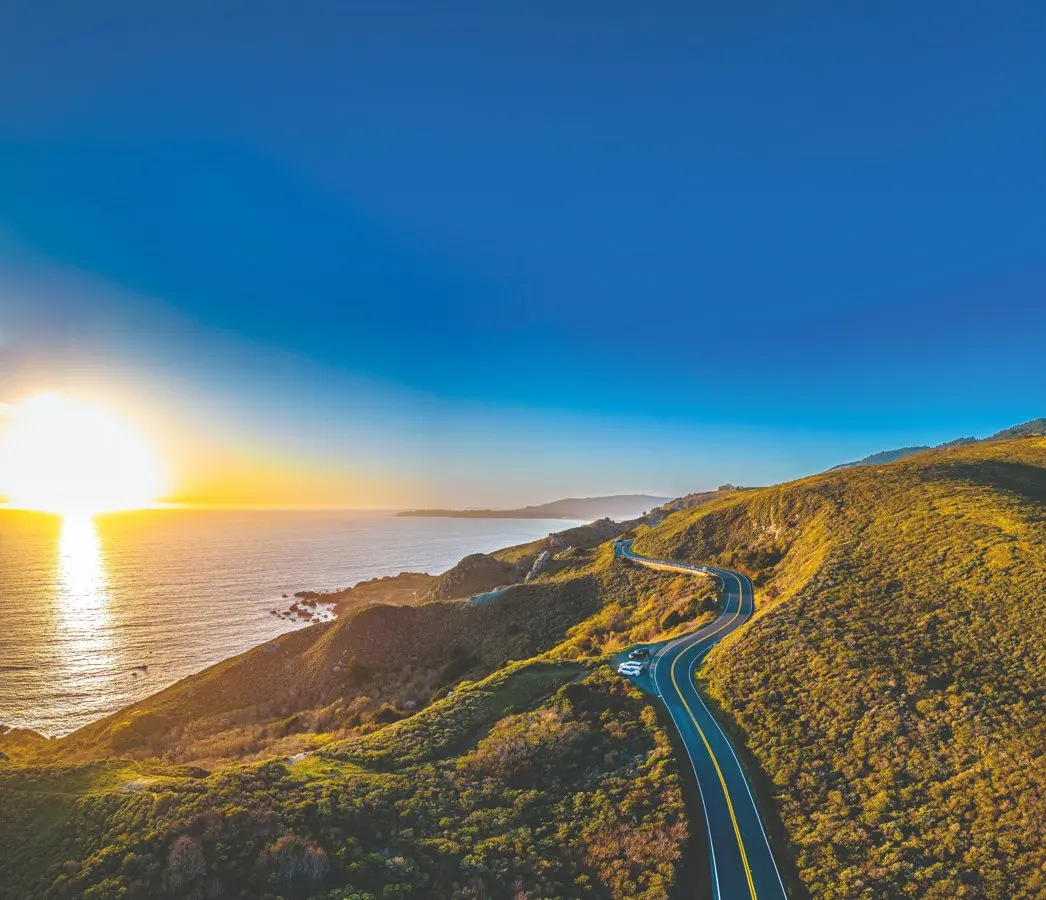
After nearly two years of closure, you can once again drive the full length of California's Highway 1. The Regent's Slide landslide severed the road near Big Sur in February 2024, cutting off coastal communities and leaving one of the world's great road trips in pieces. Through-travel finally resumed in January 2026, and despite further disruption from the Timber and Plaskett wildfires over the summer, the entire route reopened by mid-September.
The highway runs roughly 1,000km from Dana Point in Orange County — a city trademarked as the Dolphin and Whale Watching Capital of the World — north to Leggett in Mendocino County. Dana Point makes a surprisingly good starting point rather than jumping in at Los Angeles: the waters off Orange County hold more dolphins per square mile than anywhere else on the planet, with pods of 50 to 200 common dolphins regularly spotted alongside fin whales. In 2021 the World Cetacean Alliance named Dana Point a Whale Heritage Area, the first in North America and still one of only 12 worldwide.
Heading north, the road strings together the famous — Laguna Beach, Malibu, Santa Monica-adjacent LA — and the tiny, like Harmony, a village of 18 people whose old creamery now houses a glassworks and café. In Cambria, Linn's Restaurant serves pie made from olallieberries, a rare blackberry-like hybrid the family has farmed on the Central Coast since the 1980s. Owner Aaron Linn calls the highway an economic driver, and he's not exaggerating: Beacon Economics estimated the Big Sur closure cost between $13 million and $14 million in visitor spending every single month.
Big Sur remains the route's crown, with Bixby Bridge as its postcard image — but around seven million visitors descend annually on a community of fewer than 2,000 residents. Locals now ask drivers to treat the bridge as a scenic through-drive rather than a photo stop, and new parking restrictions are in place. The reward for keeping moving is the coast itself: sea stacks, peacock-blue water and a string of microclimates that make the region extraordinarily fertile.
That fertility shows up on the plate. Post Ranch Inn's restaurant Sierra Mar recently earned a Michelin Green Star for its commitment to local, regenerative and organic sourcing, working with female- and Hispanic-owned farms in the Salinas Valley — the so-called Salad Bowl of the World. Wine lovers should also look past Napa: the Central Coast pours excellent cool-climate chardonnay and pinot noir at spots like Hearst Ranch Winery overlooking San Simeon Bay, or Caraccioli Cellars in Carmel-by-the-Sea.
Two tips make the trip better. First, most travellers stop in San Francisco, but nearly 300km of highway remain — and the northern stretches toward Leggett are the quietest of all, where coastal redwoods crowd the Pacific edge and towns like Mendocino and Boonville reward a slow detour. Second, aim for autumn: the summer crowds thin, the weather stays warm and bright, and the agricultural calendar hits its stride with apples, pumpkins and the wine harvest.
With the road finally connected end to end, one of America's definitive drives is back — and it pays to keep going past the famous bits.