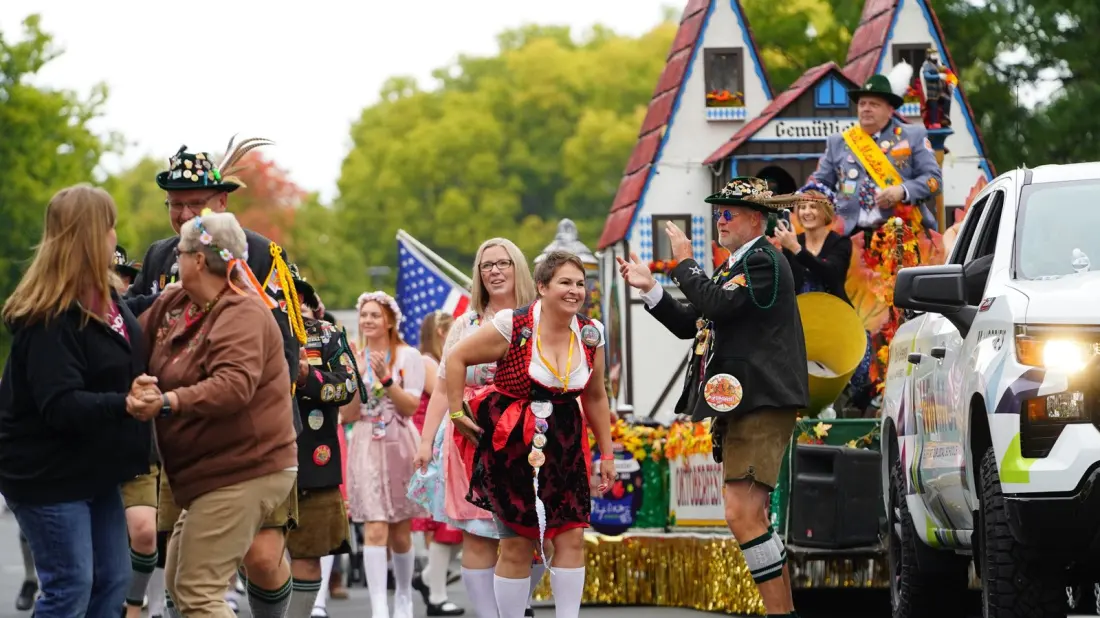
Munich may have the original, but the United States now runs an Oktoberfest season all its own — and some of it is genuinely impressive. German immigrants who arrived in waves through the mid-1800s left behind brewing towns, Alpine-styled main streets and a taste for polka that still flares up every September and October. Here are five celebrations worth building a trip around.
Cincinnati's Zinzinnati Oktoberfest is the heavyweight: the second-largest Oktoberfest on earth after Munich, drawing 700,000–800,000 people across four days and marking its 50th anniversary this year. Expect a two-story glockenspiel biergarten, a 31-foot bell tower, the Running of the Wieners dachshund race, the world's largest chicken dance, and local eats like goetta cheese fries alongside 25 beer vendors.
Tulsa's Zeeco Oktoberfest has topped USA Today's rankings three years running. It spreads 300-plus beer taps across 11 tents and stages on 140,000 square feet, with German acts like Dorfrocker, a dedicated Children's Tent, a Family Free Day, and competitions ranging from the MassKrug Carry to the Bier Barrel Race. The 2026 edition kicks off October 22.
Helen, Georgia, plays the long game. This Blue Ridge mountain town was a fading logging community until local artist John Kollock reimagined it as a Bavarian village in the late 1960s — half-timbered facades, cobblestones and all. Its Oktoberfest, running mid-September through early November at the Festhalle, is the longest-running in the country, and 2026 adds a Halloween-night costume contest. The town now pulls over two million visitors a year.
Mt. Angel, Oregon, keeps things community-sized and mostly free. Run entirely by volunteers since 1966, it grew from 39,000 attendees to a Pacific Northwest folk festival drawing hundreds of thousands. Highlights include the tallest glockenspiel in the US (49 feet), a daily noon Weaver's Dance performed by local kids, and up to 20,000 servings of sausage and sauerkraut a season. The festival has funnelled more than $3.5 million back into nonprofits.
New Ulm, Minnesota, is arguably the most authentic of the lot. Founded in 1854 by German settlers and often called the most German city in America, it sports a 102-foot Hermann Monument and Schell's Brewery, the Midwest's oldest, dating to 1860. Its Oktoberfest spans two weekends starting October 2, with a new Steinholding State Championship this year.
Honorable mentions: Frankenmuth, Michigan — 'Little Bavaria' and the only US Oktoberfest officially sanctioned by Munich, complete with imported Hofbräu beer — and Snowbird, Utah, where two Bavarian accordionists decided the Wasatch peaks looked enough like home to start a festival in 1972 that now draws over 60,000 people across ten weekends.
Whether you want big-city spectacle or small-town charm, there's a stein with your name on it somewhere in America this fall.