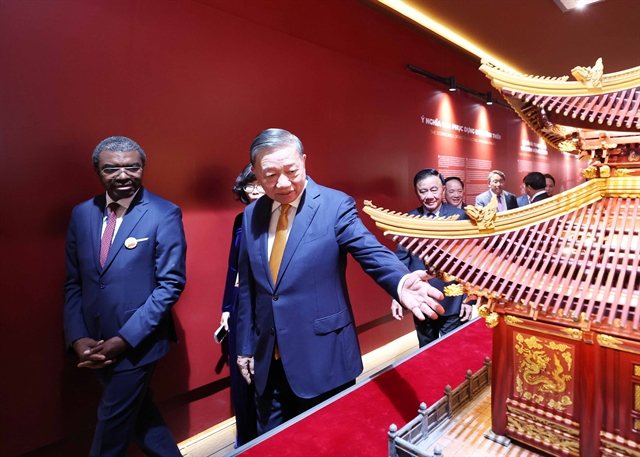
Hà Nội has officially started work on rebuilding Kính Thiên Palace, the ceremonial heart of the Thăng Long Imperial Citadel that has stood mostly in ruins for decades. The ground-breaking ceremony on September 29 was attended by Party General Secretary and State President Tô Lâm, and coincided with the Asia-Pacific Dialogue on Heritage and Authenticity, which the city hosted from September 27 to October 1.
Kính Thiên Palace dates back to 1428, when construction began under King Lê Thái Tổ and was completed under King Lê Thánh Tông, according to the Complete Annals of Đại Việt. It was the most important building in the citadel, hosting major state and diplomatic events during the Lê dynasty. After Vietnamese forces took over Hà Nội on October 10, 1954, the Ministry of Defence used the site as an office, and only in 2024 was part of it handed back to the city — clearing the way for this project.
The restoration follows 15 years of continuous archaeological research. Recent excavations at the palace site revealed a six-metre-deep sequence of stratigraphic layers showing human activity, with the oldest dating back around 1,300 years. Researchers describe it as the deepest and most complete stratigraphic record of Thăng Long–Hà Nội ever found.
The citadel itself was inscribed as a UNESCO World Heritage Site in 2010, recognised for reflecting more than 13 centuries of development as Vietnam's centre of power, with overlapping cultural layers still visible on site. UNESCO World Heritage Centre director Lazare Eloundou Assomo praised the citadel at the ceremony as a testament to both Vietnamese identity and humanity's shared past.
For travellers, this is why the citadel is worth a proper visit rather than a quick photo stop. The site's star original feature — the southern stone balustrade of Kính Thiên Palace from the Early Lê period — is on display, along with terracotta dragon ornaments and a detailed scale model showing what the palace looked like, complete with tiled roofs and dragon motifs. Once the restoration is done, visitors will be able to see the royal power centre rebuilt in full, rather than trying to imagine it from foundations and fragments.
The project is part of a long-term vision for the citadel's central axis running to 2035, nested within Hà Nội's 100-year master plan. City officials frame heritage conservation as a development resource, not just preservation — meaning expect the citadel to become an increasingly polished flagship sight over the coming decade. If you're in Hà Nội before then, you get the archaeology in raw form: excavation pits, layered remains and a rare chance to watch a lost palace come back to life.
Story via Vietnam News Life