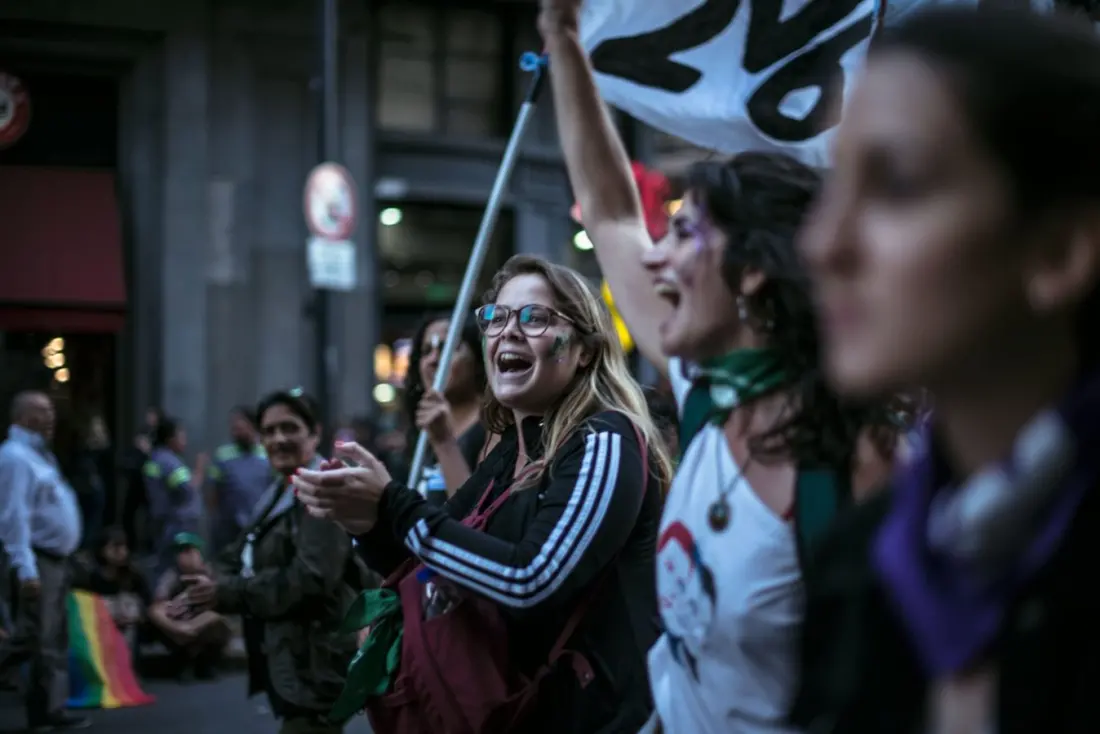
Downtown Buenos Aires filled with purple scarves, green handkerchiefs and photographs of victims on June 3 as thousands gathered outside the National Congress to mark eleven years of Ni Una Menos, the feminist movement born after the 2015 murder of 14-year-old Chiara Páez. What began as a protest against femicide has since reshaped Argentina's gender violence debate and sparked similar movements across Latin America.
This year's march was shadowed by the case of Agostina Vega, a 14-year-old from Córdoba whose femicide dominated headlines in the run-up to the demonstration. Her death triggered public fury at the justice system and calls for officials to resign over failures to protect her. Protesters also carried the names of Dulce Candia, 17, killed in Misiones province, and Noelia Romero, 30, killed in a Buenos Aires suburb.
Actress and activist Thelma Fardin read the organisers' statement — a significant choice, given her own landmark #MeToo case. Earlier this year, Brazil's Supreme Court upheld the conviction of Argentine actor Juan Darthés for abusing her during a 2009 tour in Nicaragua. Addressing the crowd, she said simply: stop killing us.
The mobilisation also took on an economic edge. The movement's classic slogan, "Vivas y libres nos queremos" (alive and free we want to be), gained a new ending: debt-free. Organisers tied gender violence to the austerity agenda of President Javier Milei, whose government feminist groups accuse of dismantling gender policies.
The numbers on each side tell competing stories. The observatory Ahora Que Sí Nos Ven recorded 99 gender-related killings between January and May this year — one woman killed every 31 hours — and more than 3,200 cases since the first march in 2015. Fact-checker Chequeado found that inflation-adjusted spending on eight gender programmes fell around 95% between 2023 and 2025, with the national hotline for victims and financial aid for women at risk effectively defunded. Six of the eight programmes were eliminated or absorbed elsewhere.
The government pushes back. Senator Patricia Bullrich of La Libertad Avanza argued femicides have dropped 25% under Milei, pointing to tougher prisons and a new DNA registry for convicted rapists. A Supreme Court report recorded 200 femicide victims in 2025 — down 12.3% year-on-year and the lowest figure since 2017, or one killing every 44 hours.
The demonstration closed the way it began: participants raised photographs of victims toward Congress while organisers read aloud the names of women killed over the past year. Eleven years on, organisers say the core demand has not shifted — that no woman becomes the next name on the list.
For travellers, the practical note is awareness: large feminist mobilisations in Buenos Aires regularly close the area around Congress and Avenida de Mayo, and June 3 demonstrations have become an annual fixture. If you are in the city on that date, expect street closures, packed public transport and a heavily policed centre — and, for many visitors, one of the most powerful civic spectacles in South America.