
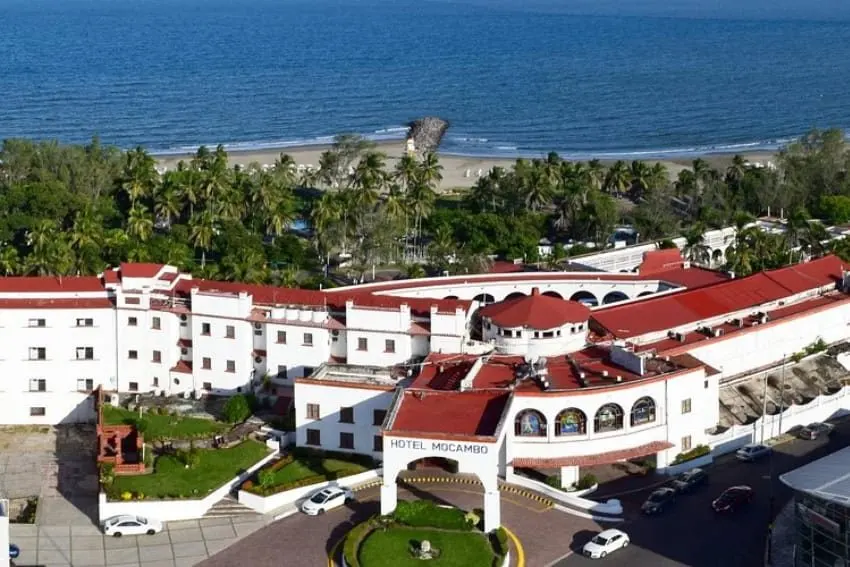
Long before Cancún's hotel zone or Los Cabos' marina towers, Mexico's beach-resort era began on the Gulf Coast. In 1938, construction started on Hotel Mocambo in Boca del Río, just south of the port city of Veracruz — widely considered the country's first grand-scale luxury beachfront resort.
The story behind it is rich. The hotel takes its name from Playa Mocambo, a word with Afro-Portuguese roots that nods to the area's history as a refuge for escaped enslaved Africans. Veracruz itself is where Spanish colonization of continental Latin America began in 1519, and the region gave Mexico coffee, vanilla and jalapeños. Now you can add beachside glamour to that list.
The design came from Jesús Martí Martín, a Spanish architect exiled after the Spanish Civil War, commissioned by Veracruz governor Miguel Alemán Valdés — who later became president of Mexico. The hotel sat atop the highest coastal hill in Boca del Río, with Moorish flourishes, arched hallways, grand staircases, breezy terraces and a pool area cascading down to the sand. It opened with 15 rooms and later expanded, under another Spanish architect, Enrique Segarra, to 110 rooms; today 70 remain, a modest figure compared with the 2,000-plus-room mega-resorts elsewhere in Mexico.
In its midcentury heyday, Mocambo was the place to be for Mexican celebrities. Singer Agustín Lara, the legendary Chavela Vargas and film star Pedro Infante were regulars. In 1943, "María Eugenia" — starring the iconic María Félix, with a cameo from Veracruz singer Toña la Negra — was shot on the property, right in the middle of the Golden Age of Mexican cinema.
Its influence on Mexican tourism is hard to overstate. Before Mocambo, Mexico's most luxurious hotels were all inland, in cities like Mexico City. Mocambo — followed quickly by Acapulco's rise — kicked off the coastal resort culture that now defines the country's tourism economy. Cancún alone accounts for 45% of Mexico's international flight arrivals, and roughly two-thirds of inbound flights land near beach destinations.
Mocambo today is a more melancholy proposition. The modern city has grown around it: high-rise apartments, busy avenues and the state's biggest shopping mall sit within walking distance. The paint is faded, the facades show wear, and the celebrities are long gone. But that's exactly the appeal for a certain kind of traveller — anyone drawn to midcentury architecture, Golden Age cinema lore, or the pleasure of standing in a place where Mexican beach luxury was invented, before the crowds moved on to Cancún and Tulum. Pair it with Veracruz's gritty, musical port-city energy and you get a coastal trip very few international visitors think to take.