
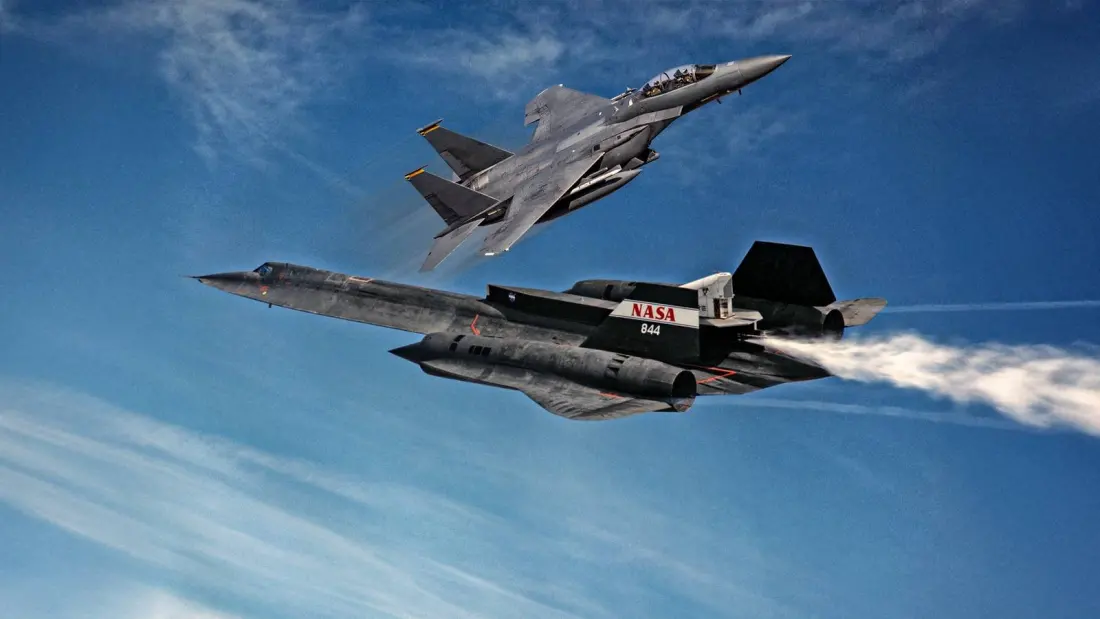
Some of the strangest sorties flown by America's legendary spy plane never went near hostile territory. From 1982, the SR-71 Blackbird — an aircraft built to photograph secret sites while flying too fast and too high to be shot down — took on a second job as a practice target for F-15 Eagle fighters out of Nellis Air Force Base, just north of Las Vegas.
The exercises were known as "Eagle Bait," and the idea was simple: give F-15 crews a chance to acquire, track and lock onto an extremely fast, high-flying target, then simulate a Sparrow missile shot. What made the Blackbird such an appealing target also made it nearly impossible to catch. It cruised between 80,000 and 85,000 feet — high enough that 95 percent of the atmosphere sat below it — and could hold Mach 3 for over an hour. Its top recorded speed was Mach 3.32, set in July 1976. In its operational life it was reportedly fired at more than 4,000 times and never hit.
Even with the deck stacked in the fighters' favour, the Eagles struggled. Blackbird crews flew straight, level lines at constant speed while ground controllers fed the fighters range and bearing data, and both sides shared a radio frequency. It didn't help much. The F-15's fire-control system had a speed gate — the range of closing velocities it could process — capped at 1,500 knots. A head-on pass against a Blackbird cruising at 1,900 knots produced closing speeds around 2,500 knots. As one SR-71 pilot put it, at those speeds the Blackbird simply didn't register on the Eagle's radar: it was filtered out as invalid clutter. The fix came through software rather than hardware, and later APG-70 radars with programmable processors handled it better.
The missiles had problems too. An AIM-7 Sparrow launched from 25,000 feet struggled to climb to 55,000 feet, and its fins were designed for denser air — too sluggish to manoeuvre at 80,000 feet, where a closing speed near Mach 6 meant the impact point had to be predicted almost a mile per second in advance. F-15 crews eventually got special dispensation to zoom-climb to 50,000-55,000 feet before a simulated launch, spending up to 90 seconds above 50,000 feet without pressure suits.
Even then, the usual radio call from fighters flashing past far below was, "we're too late." The exercises, described by retired Colonel Richard H. Graham in his book on flying the Blackbird, showed that shooting down the SR-71 was never as simple as getting close enough to fire — a lesson even America's own premier fighter had to learn the hard way.
Why does this matter to a traveller? Because the stage for this Cold War drama sits right in the Nevada desert most visitors only see from a casino rooftop. Nellis is an active base, but aviation-minded visitors to Las Vegas can catch related military aircraft at the Nevada State Museum in Carson City or the Thunderbirds' home turf at nearby Nellis, and the area's restricted ranges still host the kind of high-speed training the Blackbird once made famous.