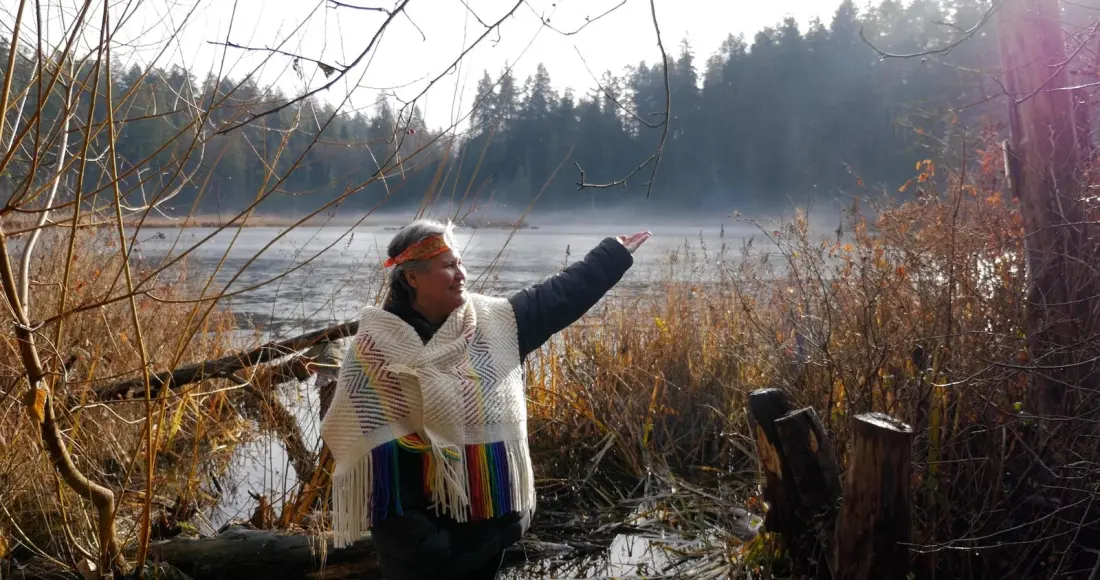
On a beach in Porpoise Bay Provincial Park on British Columbia's Sunshine Coast, a guide points to a shell midden — thin layers of white fragments pressed into an eroded bank, each one a record of thousands of years of Indigenous life. That moment captures what Talaysay Tours does: it turns a walk in the forest into a lesson in how the Shíshálh (Sechelt) Nation has lived with, and cared for, this land for millennia.
The company was co-founded in 2002 by Candace Campo, a member of both the Shíshálh and Sḵwx̱wú7mesh (Squamish) Nations, making it one of BC's early Indigenous tourism operations. Campo spent her first years running tours each summer alongside other jobs, then in 2016 left a career teaching art, history and the Sechelt language to run the business full-time. Her daughter Talaysay, who grew up with the company and gave it its name, is now its CEO at 28 — Campo has shifted her own focus to community development and mentoring young cultural ambassadors.
Tours run in Vancouver's Stanley Park, Squamish, Whistler and the Sunshine Coast, covering ethnobotany, oral history, language, art and ecology. The one-hour Salish Sea and Me experience in Porpoise Bay includes standing beneath an old Western hemlock, learning how cedar shaped every part of coastal life, and finishing with a steaming cup of hush tea — a medicinal drink that tastes of licorice. Guests are treated as learners rather than consumers, with an emphasis on treating the land like a relative: take thoughtfully, waste nothing.
Campo's story is shaped by heavy history — her mother survived severe abuse in residential school, and her Nation was among the first in BC to win self-governance, which Campo witnessed at 13 when her Chief spoke to her class about sovereignty. She's candid that language and cultural restoration is happening too slowly for her liking, but sees real progress in the work her generation and her daughter's are doing.
The business side is growing fast, too. Talaysay has partnered with Destination BC, Indigenous Tourism BC and the Indigenous Tourism Association of Canada, and recently signed a long-term deal with Intrepid Travel, which aims to include Indigenous-led experiences in 75 percent of its Canadian itineraries by 2027.
For travellers, this is a genuinely different way to see BC's most-visited corners. A Stanley Park walk you might otherwise do with a map and an ice cream becomes a lesson in which plants are medicine, which trees fed whole cultures, and whose unceded territory you're standing on. Expect walks, paddling trips and workshops rather than a performance — and come curious.