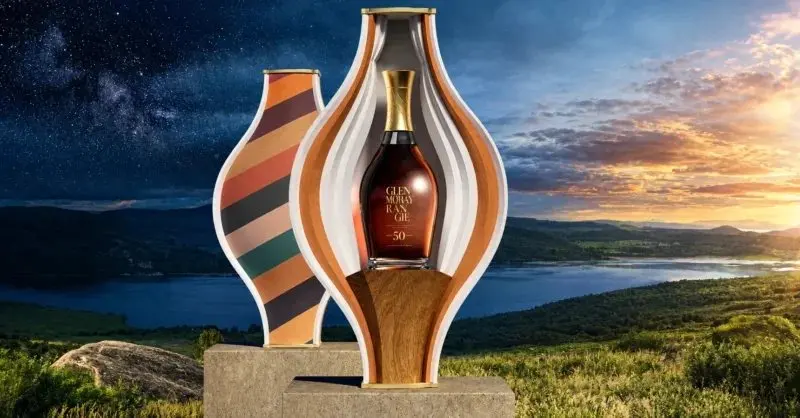
Glenmorangie has just released the oldest whisky in its history — a 50-year-old single malt limited to 149 bottles, priced at £25,800 (roughly $34,200). But the striking part is that the bottle arrives fused with a piece of art: American ceramicist Peter Pincus and his wife Laurie have built a tessellated porcelain structure around it, in bands of rust, blue, pink, ochre and gray, with no obvious front or back. Each of the 149 pieces is slightly different, and the installation — titled Together in Spirit — will now be split up, every buyer taking home one fragment of a single artwork.
The whisky itself has an unusual backstory. Dr Bill Lumsden, Glenmorangie's director of whisky creation, assembled a 25-year-old recipe in 1999 from 75 percent first-fill bourbon casks and 25 percent first-fill Oloroso sherry casks, then married a small parcel and transferred it into a refill bourbon hogshead that had given up most of its flavor long before. He had it recoopered tightly at Speyside Cooperage to guard against leaks, letting the delicate spirit — from the distillery's famously tall stills — age slowly in Glenmorangie's cool, damp warehouses. He never planned on 50 years; he simply kept tasting until, about three years ago, he judged it ready.
The barley adds another layer of rarity: it came from the final batches of the distillery's own floor maltings, which closed in 1977. That leaves a faint, dry, ashy smokiness you won't find in modern Glenmorangie — Lumsden calls it a throwback to another era. At the launch at Gleneagles, tasters found it surprisingly vibrant after half a century: toffee and raisin on the nose, a soft, buttery palate of orange peel, pepper and cumin, with that residual smoke underneath rather than on top.
Pincus, who teaches ceramics at the Rochester Institute of Technology and jokes he's worked seven days a week since discovering the craft in high school, describes ceramics as 'the first form of journalism' — vessels outlasting their contents and the people who made them. His studio spent more than three years on new molding techniques and dozens of bespoke pigments, translating the whisky's flavors and smells into color. Lumsden admits the result is bittersweet: some buyers may never dare to open the bottle. Both he and Pincus would rather people drank it, but the fact that anyone hesitates says something about how completely the liquid and the ceramic have been conceived as one thing.
For travellers, the story is a snapshot of where luxury Scotch is heading — whisky as collectible art, launched at storied Scottish estates like Gleneagles rather than in tasting rooms. Even if the 149 bottles are out of reach, the Highlands whisky trail behind this release is very much open to everyone.