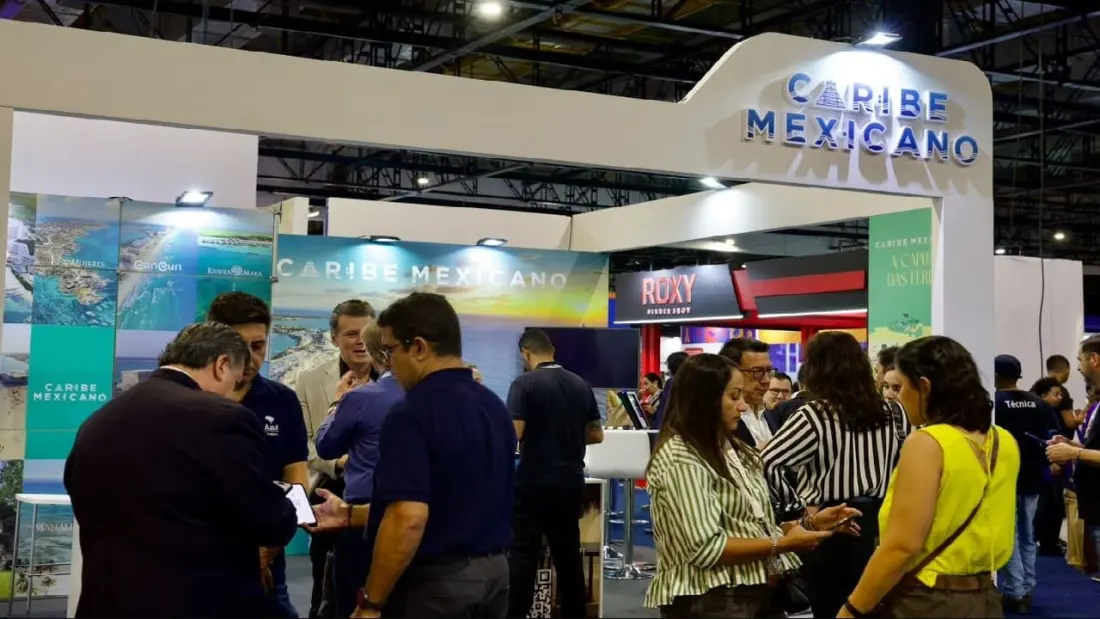
Mexico's Caribbean coast is making a deliberate play for Brazilian holidaymakers. Quintana Roo, the state home to Cancún, the Riviera Maya, Tulum and the Riviera Maya's beach towns, showed up in force at ABAV Expo 2026, one of Latin America's biggest tourism trade fairs, with a full promotional agenda aimed at Brazilian tour operators, wholesalers and travel agencies.
State tourism secretary Bernardo Cueto framed Brazil as a strategic market. The numbers back him up: in 2025 Quintana Roo welcomed 68,283 Brazilian tourists and 51,658 Brazilian air passengers, meaning the state captured 43.9% of all Brazilian air arrivals in Mexico. In other words, nearly half of Brazilians flying to Mexico already head for the Mexican Caribbean, and the state wants to keep it that way. As part of the push, the Mexican Consulate in São Paulo was even rebranded under the campaign "The Mexican Caribbean, the world capital of vacations."
The timing is no accident. On February 5, 2026, Mexico's electronic visa for Brazilian nationals came into effect, removing a major friction point for leisure travel. Between February 5 and September 25, 2026, more than 60,000 e-travel authorisations were issued, over 30,000 of which have already been used. The impact shows in the arrivals data: Brazilian tourism to Mexico rose 26.3% between February and July 2026 versus the same stretch of 2025, and July 2026 alone saw a jump of nearly 40% year on year.
For context, Brazil is Mexico's sixth-largest international source market and the second in Latin America, behind only Colombia. The push from Quintana Roo is about defending and growing that position amid competition from other Caribbean and long-haul destinations courting the same Brazilian spend.
Why should a traveller care? If you're Brazilian, getting to Cancún or Tulum just got simpler — the electronic authorisation streamlines tourist trips, and the market push usually translates into more direct flights, package deals and Portuguese-friendly services on the ground. For everyone else, it's a sign the Mexican Caribbean is doubling down on South American connectivity, which often means more route options and competitive fares through hubs like Cancún. Expect the usual draw cards to keep doing the heavy lifting: Caribbean beaches, Mayan sites like Tulum and Chichén Itzá nearby, cenotes, and a hotel scene running from all-inclusives to boutique eco-lodges.
The takeaway: Brazil-to-Mexico travel is in a clear growth phase, and Quintana Roo intends to be the landing spot for most of it.