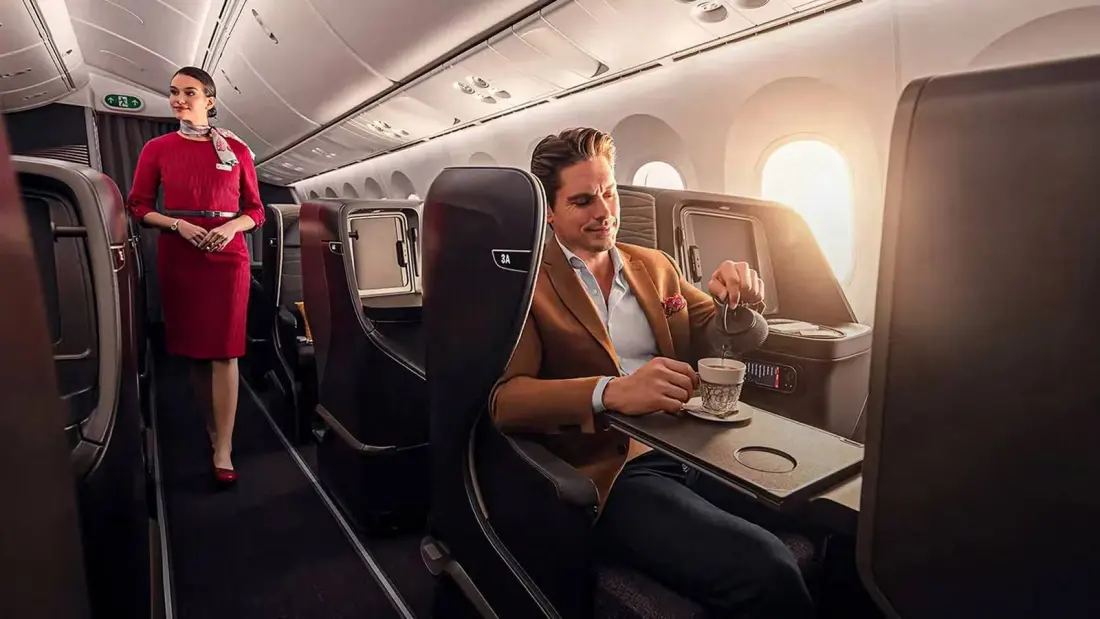
Turkish Airlines has built its reputation on an open, sociable business class and some of the best catering in the sky. That is about to change. The Istanbul-based carrier has unveiled the "Crystal Suite", a privacy-first business class seat with a door, developed in-house by its subsidiary TCI Aircraft Interiors. Expect plush leathers and fabrics sourced in Türkiye — a deliberate nod to the airline's roots.
The rollout timeline is concrete: installations begin on newly delivered Airbus A350s in early 2027, with Boeing 777-300ER refurbishments to follow. That will replace the current lie-flat seats on those types and close the gap with rivals. Turkish's 787s and A350s already offer a 1-2-1 layout with full-flat beds and privacy screens between middle pairs, but the ageing A330 still flies a much more open 2-2-2 configuration.
There may be a second cabin tier coming too. CEO Ahmet Olmuştur says premium economy is under active discussion for widebodies from 2028, potentially taking 8-9% of current economy capacity. His justification: airline research suggests roughly two-thirds of long-haul passengers would pay extra for more legroom and comfort. Nothing is officially announced yet, but the logic is hard to argue with — global demand for premium leisure travel, and premium economy in particular, has surged.
Why the change? Money, mostly. Turkish posted a $2.2 billion operating profit in 2025 with revenue up 9.7%, driven largely by premium cabin performance. Chairman Ahmet Bolat has noted the airline suspended 18 low-yield routes amid global instability, and yield protection is now central to the strategy. Segmented cabins — doors on suites, a proper middle tier — turn cabin space into more predictable revenue. It also puts Turkish in direct competition with Lufthansa, Air France, Emirates and Qatar Airways, carriers it already battles for connections between Western Europe and India, East Asia and Africa.
One wrinkle worth watching: some of Turkish's 30-plus A350-900s were taken over from pending Aeroflot orders after sanctions hit Russian airlines. Those airframes arrived with mixed interiors — some with Stelia Symphony seats, others with Collins Aerospace Horizon suites that already have privacy doors and a hidden premium-economy section. Whether Turkish retrofits everything into a single unified suite product, or keeps flying a patchwork of configurations, will reveal how coherent this strategy really is.
For travellers, the practical takeaway is simple: if you're booking Turkish long-haul business class in the next year or so, the seat you get depends heavily on the aircraft. A 777 or A330 flight in 2026 will look very different from an A350 delivered after early 2027. If you've been holding off on a big trip via Istanbul — perhaps a two-centre break combining the city with a long-haul connection onwards — the 2027 Crystal Suite rollout is a good reason to time it right. And if premium economy does land in 2028, Turkish could become one of the more interesting ways to fly long-haul comfortably without paying full business fares.
Details first reported by Simple Flying, drawing on Forbes, Aviation Week and Turkish Airlines' own guidance.