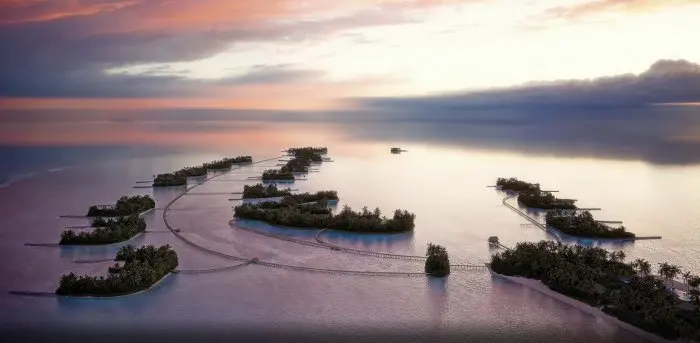
Aman has revealed plans for Amanolu, its first resort and residential project in the Maldives, and the details are as audacious as you would expect from a brand with a cult-like following. Set in Vaavu Atoll, one of the country's least developed and most pristine regions, the project pairs a 52-key resort with 16 Aman Residences. Each five-bedroom residence sits on its own entire private island, complete with a dedicated beach, a 25-metre pool, staff quarters and a personal boat berth.
The scheme goes further than the usual ultra-luxury playbook. Alongside the resort and residential islands, there will be separate islands devoted entirely to wellness and to recreation, so guests can move between distinct private environments rather than sharing one resort footprint. The name itself blends Aman (Sanskrit for peace) with Olu, drawn from the water lily and its associations with calm and renewal.
Design duties fall to KHA, the architecture practice founded by the late Kerry Hill, whose portfolio includes many of Aman's most admired properties. Expect the group's signature restraint: light, proportion and landscape doing the heavy lifting, with indoor and outdoor spaces deliberately blurred. Reports point to a 2028 opening, though Aman is currently saying only "coming soon".
The timing is telling. The announcement landed just days after the Government of Maldives and Abu Dhabi developer Eagle Hills agreed commercial terms for Maldives Waterfront and Marina, a large integrated destination at Ras Malé with hotels, residences, a marina, retail, dining and community infrastructure. In other words, within a single week, both an intimate ultra-luxury retreat and a major scale waterfront development chose the Maldives. That is a strong signal about where the destination's brand and investment appeal stand.
For travellers, Amanolu represents the logical endpoint of a trend already reshaping high-end holidays: the world's wealthiest guests increasingly want control over their time and surroundings, not just a big villa. Here, the villa becomes an island and the spa becomes its own island. Even by Maldivian one-island-one-resort standards, the ambition is notable.
There are fair questions ahead about infrastructure, environmental impact and how much of the economic benefit reaches Maldivians as the country enters this next phase of growth. The reefs and lagoons around these projects are not scenery; they are the product. But the headline for now is straightforward: one of hospitality's most respected names has placed the Maldives at the centre of its expansion, and Brand Maldives looks stronger than ever.