In the small timber town of Walpole, on Western Australia's south coast, artist and palaeoecologist Dr Elizabeth Edmonds paints with ink made from peat core samples up to 6000 years old, drawn from the wetlands scattered between the forests near her family farm. Her Petrichor Gallery on the main street displays works in sepia tones she calls her "Walpole palette" — each artwork carrying microscopic pollen, charcoal and climate records from deep time.
That art-science crossover is the public face of PEAT Southwest, a five-year research project co-led by the University of Western Australia and Edith Cowan University, with nearly $4.68 million in grants from the Ian Potter Foundation and Lotterywest. The team — zoologists, fire ecologists, hydrologists and soil scientists — is mapping the peatlands of south-west WA, from Walpole through to Windy Harbour, and working out how to protect them.
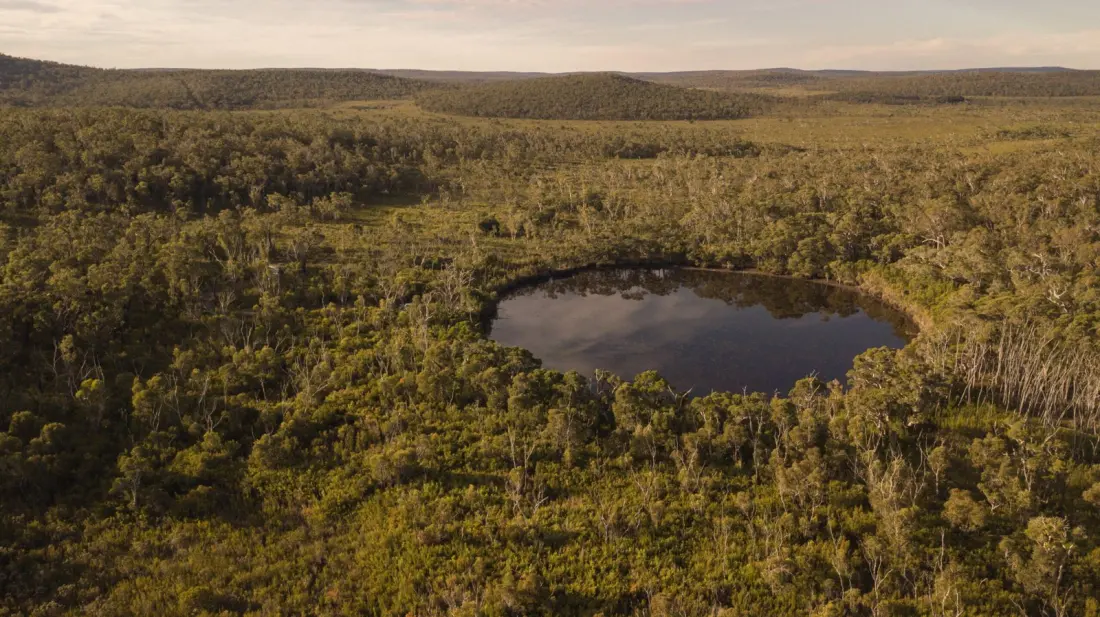
Why bother about soggy black soil? Because peatlands punch far above their weight. They cover just 3 per cent of the world's land surface but store twice as much carbon as all the planet's forests, making them the largest terrestrial carbon sink. They also filter rainwater and preserve 10,000-year environmental archives. South-west WA sits inside a recognised global biodiversity hotspot, and its peatlands shelter creatures found nowhere else: carnivorous Albany pitcher plants, the sunset frog with its technicolour belly, and the salamanderfish — a Gondwanan relic that buries into the peat to survive summer.
The threats are drying climate, feral pigs and fire. Once a peat bed ignites, it can smoulder underground for months, and a layer that took 5000 to 10,000 years to form can be destroyed in one blaze. Researchers have recorded some peatlands bone-dry for half the year. After a four-year campaign and an estimated 20 peat swamps lost, the Empodisma peatlands were finally listed as a threatened ecological community in September 2023 — though tensions remain with the state agency over prescribed burns that conservationists say are too frequent for species like quokkas and honey possums, which need decades between fires.
For travellers, Walpole offers a rare chance to see these odd little worlds up close. Each year the Walpole Wilderness BioBlitz, a two-day citizen science event, sends hundreds of volunteers — kids to retirees — into the jarrah, karri and giant red tingle forests to record wildlife, including the peatlands themselves, most averaging just 4 or 5 hectares. It's a genuinely hands-on way to visit one of Australia's least-known ecosystems, in the only designated wilderness area in the continent's western third.
Whether you come for the tingle trees, the pitcher plants or an artist's gallery of paintings made from millennium-old mud, Walpole makes a compelling case that the humblest habitats can be the most extraordinary — and the most worth saving.
Story via Australian Geographic.