Rovos Rail's most ambitious itinerary is also its rarest. The Copper Trail, run by the Pretoria-based luxury operator, covers roughly 3100 kilometres over 15 days, tracing one of the world's great — and least-travelled — rail routes from Victoria Falls in Zimbabwe through Zambia and the Democratic Republic of the Congo to the Atlantic port of Lobito in Angola. It's only run a handful of times since its 2022 maiden trip, following founder Rohan Vos's years-long battle to secure permissions for the notoriously dilapidated stretch through the DRC.
The route follows the Lobito Corridor, an EU-backed freight line that could become Africa's first true transcontinental transport link, carrying copper from the belt straddling Zambia and the DRC to the coast. Angola's Benguela Railway, rebuilt with Chinese funding after the civil war, is in good shape; the Congolese section is another story, with track so poor it was previously deemed undoable. Vos, now 80, surveyed it himself on a hand-trolley before committing.
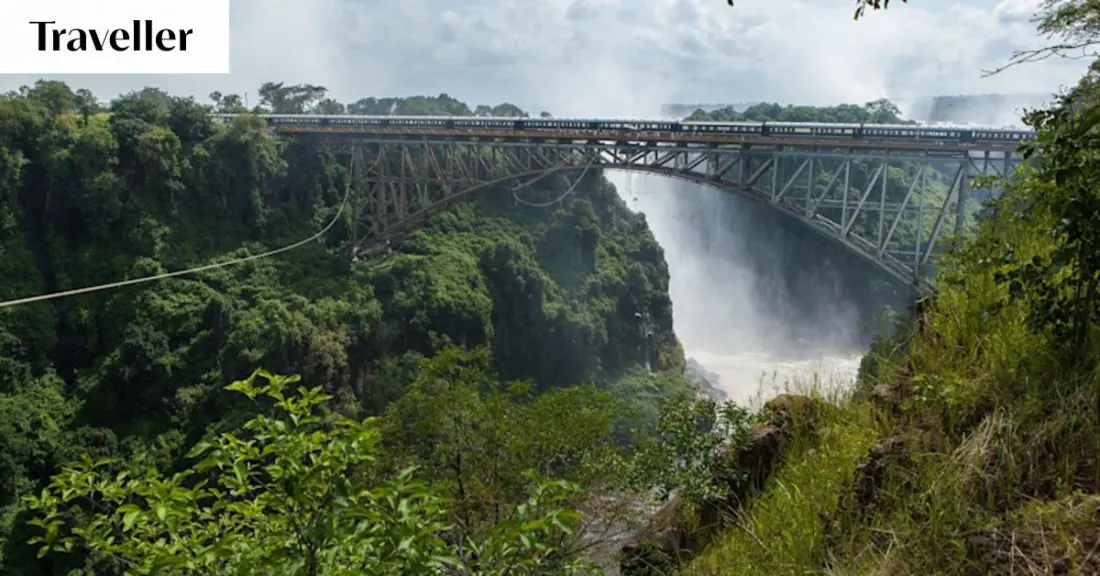
The journey begins with a theatrical flourish: the gleaming forest-green Pride of Africa pauses on the Victoria Falls Bridge so passengers can step off and watch the falls thundering into Batoka Gorge behind it. Onboard, 57 passengers — many solo, some on their umpteenth Rovos trip — settle into wood-panelled suites with en suites and minibars, and settle in for long, hypnotic days of watching Zambia scroll past the windows.
Off-train excursions give the trip its substance. There's a stop in Lusaka to meet orphaned elephant calves at a Game Rangers International sanctuary in Lusaka National Park, a four-day safari detour by charter flight to South Luangwa National Park from Ndola, and city visits in the DRC — Sunday Mass at Lubumbashi's Saint Peter and Paul Cathedral, malachite pendants at the Malachite Market, and an armed-escort tour of Kolwezi that includes an open-pit copper and cobalt mine and busts of everyone from King Leopold II to Mobutu.
It's not all smooth gliding. A diesel tanker dislodged from the tracks near Kolwezi; the DRC visa process frazzled nerves (the operator refuses to pay bribes); and not everyone along the line welcomes the train — some villagers waved warmly, while others threw stones, a reminder of the inequality inherent in a luxury train rolling through mining country. The journey also passes environmental sore spots, including a river affected by a tailings dam collapse at a Chinese-owned copper mine.
Who is this for? Railway obsessives, slow travellers and anyone who wants to see central Africa from a moving, catered vantage point rather than a 4x4. Expect four-course dinners with Cape wines, a resident historian, and station names — Kapiri Mposhi, Sakania, Dilolo — that read like poetry. It's expensive, logistically fraught and utterly singular, which is precisely the appeal.
Credit: Traveller (Sydney Morning Herald)