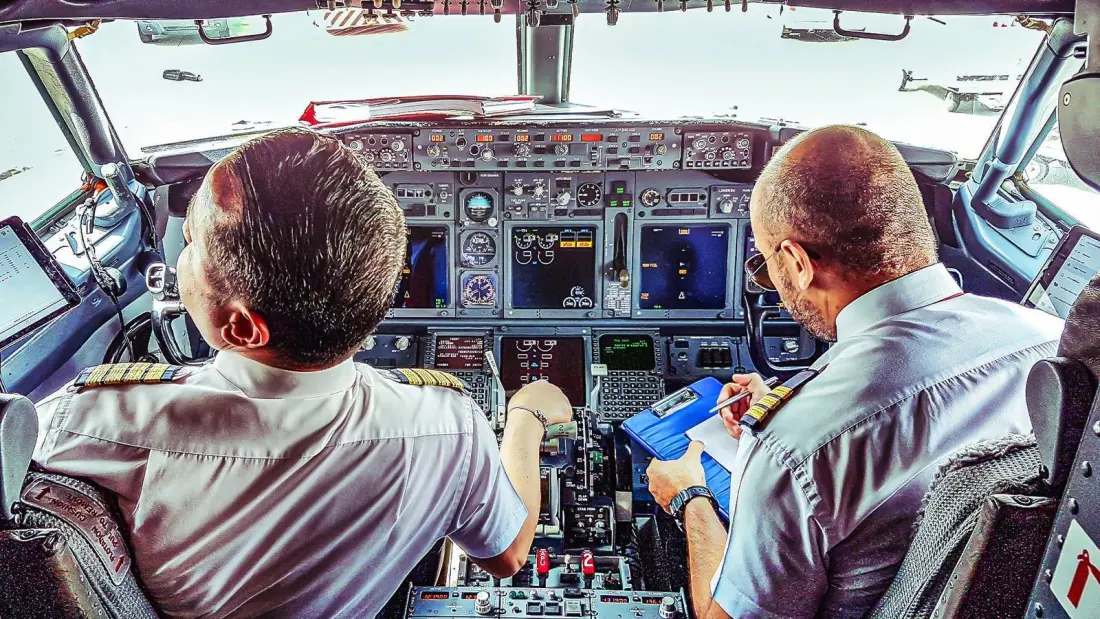
That nonstop Singapore to New York flight doesn't work because pilots tough it out at the controls for 18 hours straight. It works because airlines schedule extra pilots and purpose-built sleeping areas into the operation — and regulators like the FAA have written the whole system into law.
On typical flights, two pilots share the flight deck. Ultra-long-haul routes use what regulators call an augmented crew: more qualified pilots than the aircraft's minimum, allowing crew members to rotate off duty for protected rest while others fly. Under the FAA's rules, the number of allowable duty hours depends on how many pilots are aboard and what kind of rest facility the aircraft has. A crew of four starting a duty period between 0700 and 1259 with a top-spec rest facility can be on duty up to 19 hours; the same crew with the weakest facility gets just 15.5.
Those facilities come in three classes. Class 1 is the gold standard: a separate compartment with a flat bunk, temperature and light control, and protection from noise and disturbance — usually hidden above the cabin ceiling or below the floor on widebody aircraft. Class 2 is a lie-flat seat screened from passengers by a curtain. Class 3 is little more than a seat that reclines 40 degrees with foot support. The aircraft's interior configuration, in other words, directly determines how long it's legally allowed to fly.
The rotation is tightly scripted. The pilot who will land the aircraft must get two consecutive hours of rest during the second half of the duty period, and the pilot monitoring the landing needs 90 minutes. At least one qualified pilot stays at the controls at all times. Timing matters because sleep quality in the air is worse than on the ground — regulators define a circadian low window between 0200 and 0559, and scheduling must account for whether a pilot is acclimated to the local time zone. Rest requirements also extend beyond the flight: pilots need at least ten hours off before duty, and after certain trips spanning more than 60 degrees of longitude and 168 hours away, they may be entitled to a 56-hour recovery period covering three physiological nights.
For travellers, this is quietly reassuring: the nonstop routes airlines keep adding between distant city pairs only work because fatigue is engineered out of the operation, not left to endurance. It also explains why some ultra-long-haul routes use larger crews than others, and why cabin design debates increasingly weigh crew rest space against passenger seats. If you've ever wondered why the flight deck door opens mid-flight and a third pilot wanders back to a hidden compartment — that's the system doing its job.
As carriers push even longer nonstops, expect more attention on fatigue-risk modelling and better rest environments rather than just bigger bunks. The principle stays the same: someone qualified and rested is at the controls when it matters most — departure, approach, and landing.